The Mitsubishi A Series: Revolutionizing Industrial Automation
Introduction
In today’s fast-paced world, industrial automation is critical in improving efficiency, productivity, quality, and safety in an extensive range of industries. At the heart of industrial automation lies Programmable Logic Controllers (PLCs), which are the brains behind monitoring and controlling industrial processes.
PLC-based control systems can automate a specific machine function, industrial process, or even an entire production line. They are widely used in many industrial automation applications. They offer unique benefits, including quicker response times, precise control, increased consistency and accuracy, exceptional flexibility and scalability, real-time operation, improved efficiency, enhanced reliability, increased productivity, and improved safety.
The Mitsubishi A Series, a segment of Mitsubishi Electric products, offers reliable and performance-proven MELSEC-A programmable controllers that enhance industrial automation with easy usability and meticulous control. This article explores the MELSEC-A Series PLCs’ role in revolutionizing industrial automation.
The Mitsubishi A Series
As previously stated, the Mitsubishi A Series offers a comprehensive lineup of general-purpose MELSEC-A Series programmable controllers that stand out as versatile and user-friendly PLCs, ensuring seamless and efficient control across different industrial automation applications. Due to their extreme versatility, these controllers find use in small-scale, stand-alone, medium-scale, and large-scale industrial control systems.
MELSEC-AnS
The MELSEC-AnS PLCs are compact-type modular programmable controllers with small size, ease of use, and diverse communication and networking capabilities. The compactness makes them ideal for automation applications with limited space, like in switchgear cabinets. At the same time, the diverse communication capabilities guarantee flexibility and communication openness.
With an expandable I/O capacity of 32 to 1024 I/O points, the MELSEC-AnS PLCs are particularly well suited to perform small to medium automation tasks. Also, they are capable of high-speed automation with the A2ASCPU CPU model. You can install several MELSEC-AnS controllers in a local network (i.e., MELSECNET), enabling them to communicate with each other easily. This also increases the number of supported inputs/output points several times over.
Key Features:
- Compact dimensions that provide greater installation flexibility
- I/O capacity can be expanded from 32 to 1024 I/O points
- Provides up to 60k Steps of program memory
- Multiple communication and networking options
- All AnS CPUs include a built-in RAM of up to 256 Kbyte, in which the PLC program, among other things, can be saved.
- Supports optional EEPROM and EPROM memory cassettes for permanent storage
- An integrated backup battery in all AnS CPU modules for protecting the contents of the PLC memory
- Innovative technology that allows future expansions and adaptation to existing industrial control systems
The MELSEC-AnS series provides users with customized performance through seven different CPUs:
- A2ASCPU: This is the most powerful CPU model in the AnS series. It’s designed to handle extremely fast automation tasks with a program memory of 14k Steps and up to 512 input/output points.
- A2ASCPU-S1, A2ASCPU-S60, and A2ASCPU-S30: These three AnS CPUs are an extended version of the A2ASCPU model. They can control up to 1024 I/O points with a PLC program memory of 60k Steps for the A2ASCPU-S60, 30k Steps for the A2ASCPU-S30, and 14k Steps for the A2ASCPU-S1. With a faster processing speed of up to 0.15µs (microseconds) per logical instruction, the three AnS CPUs can also perform time-critical automation tasks. The A2ASCPU-S60 and A2ASCPU-S30 are particularly intended for very complex automation applications.
- A1SHCPU: This is the standard AnS CPU with a PLC program memory of 8k Steps and an I/O capacity of 256 I/O points
- A2SHCPU: It’s a more powerful alternative to the A1SHCPU with a program memory of 14k Steps and an I/O capacity of 512 I/O points.
- A2SHCPU-S1: This is the upgraded version of the A2SHCPU. It includes a PLC program memory of 30k Steps and can support up to 1024 I/O points.
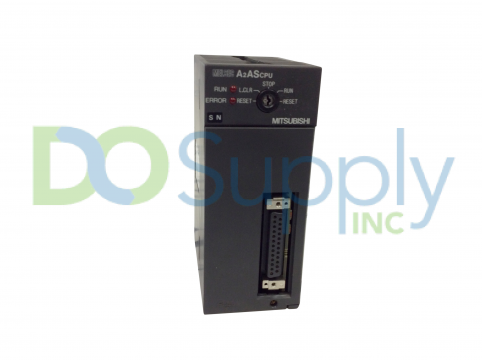
Note: All the MELSEC-AnS CPU types outlined above can be integrated seamlessly. Also, the MELSEC AnS Series is a member of the Mitsubishi MELSEC PLC family, which offers CPU compatibility across the range.
MELSEC-QnAS
The MELSEC-QnAS is an extremely compact and extra powerful new generation of MELSEC-A Series programmable controllers from Mitsubishi Electric. Outstanding features include increased network access speed, adequate memory (up to 2 Megabytes) to handle vast amounts of data, and fast program cycles.
The QnAS controllers are ideally designed to handle medium-scale automation applications requiring up to 8192 remote inputs/outputs or 1024 centralized inputs/outputs in the switchgear cabinet. Also, the MELSEC-QnAS series is hardware-compatible with the MELSEC-AnS series – so if you’re upgrading to the QnAS series, you can continue to use your AnS modules.
Key Features:
- High program execution speed
- Program memory capacity: up to 60k program steps
- Extremely fast network access; the high-speed network access features in any QnAS CPU require the A1S38HB Mitsubishi high-speed base unit along with an appropriate network card
- All conventional QnAS I/O modules (both digital and analog), as well as QnAS positioning modules, can be used on the A1S38HB high-speed base unit
- A 240 KB (kilobytes) integrated RAM memory can be easily expanded to up to 2 MB (megabytes) by slotting it into a PCMCIA RAM card.
- Available with PCMCIA EEPROM cards for permanent storage of PLC programs
- A built-in battery for protecting the data stored in the internal RAM of the QnAS CPUs against power failures
- A MELSEC-QnAS control system can be upgraded to a maximum I/O capacity of 1024 centralized inputs/output points or 8192 remote I/O points.
- Full compatibility with existing A1S hardware
The MELSEC-QnAS series offers four different CPU models for tailoring configurations to your specific automation needs:
- Q2ASCPU: This CPU model features a program execution period of 0.15µs (microseconds) per logical instruction, 28k Steps of program memory, and it supports up to 512 inputs/output points on the system rack.
- Q2ASCPU-S1: This model includes 60k Steps of program memory, a processing speed of 0.15µs per logical instruction, and can support a maximum of 1024 inputs/output points on the base unit.
- Q2ASHCPU: It features a 0.075µs processing speed per basic logical instruction, an I/O capacity of 512 input/output points on the standard base unit, and a program capacity of 28k Steps.
- Q2ASHCPU-S1: It has a high program capacity of 60k steps, a processing speed of 0.075µs per logical instruction, and can control up to 1024 inputs/output points on the base unit.
MELSEC-QnA
The MELSEC-QnA PLC Series features high-level performance and a large program memory capacity to support any industrial automation system. It brings enhanced basic and system performance, user-focused programming, easier debugging and maintenance, and a wide range of useful features.
Key features:
- Basic LD instructions processing speed: varies from 0.2µs (microseconds) to 0.15µs and to as low as 0.075µs per basic LD instruction.
- Data Memory capacity: up to 29k Words, comprising latch relays (L): 8192 points, normal timers: 2048 points, internal relays (M): 8192 points, and data registers: 12288 points. You can change the amount of memory allocated to each type of device to suit the needs of your application.
- Program capacity: up to 124k Steps
- As a standard feature, the QnA CPUs have an internal memory of up to 496 KB (kilobytes) to store parameters and PLC programs.
- The QnA CPUs can support up to two 2MB (2036 KB) memory cards. These memory cards are optional and store file registers, comments, statements, and PLC programs.
- I/O capacity: 512 to 4096 I/O points; this I/O capability is can be expanded up to 7 levels
- Legacy MELSEC-QnA control systems can be upgraded to control systems with the increased functionality and faster processing speed of the AnCPU control system by simply replacing some special function units and the sequencer CPU
- Using the QnA CPUs, you can freely access other resources in a MELSEC-NET/10 network system from serial communication modules, sequence programs, peripheral devices, etc. Also, you can similarly access other nodes connected in a serial communication multidrop link system.
The MELSEC-QnA series includes four CPU models:
- Q2ACPU: It features a basic LD instruction processing speed of 0.2µs/step, 28k Steps of program memory (112 KB (kilobytes) internal memory), and 512 I/O points.
- Q2ACPU-S1: This CPU offers a program memory capacity of 60k Steps (240 KB internal memory), a basic LD execution time of 0.2µs/step, and a maximum of 1024 I/O points
- Q3ACPU: It includes 92k Steps of program memory (368 KB internal memory), a program execution speed of 0.15µs per basic LD instruction, and can control up to 2048 input/output points.
- Q4ACPU: This is a high-performance CPU with a low processing speed of 0.075µs per basic LD instruction, a program capacity of 124k Steps (496 KB internal memory), and supports up to 4096 input/output points.
MELSEC-Q4AR
The MELSEC-Q4AR Series includes the Q4ARCPU, a CPU module to which the following functions have been added to the Q4ACPU – a MELSEC-QnA Series CPU model.
- CPU redundant functions
- Faster integer calculations
- Accelerated real number operations
- PID control (process value derivative type, partial derivative type, and velocity type) using process control instructions
- A reset selection and external output hold function for whenever operation-stoppable errors occur
Key Features:
Some of the key performance specifications of the Q4ARCPU module include:
- Basic LD instruction processing speed: 0.075µs per step
- Program memory capacity: a maximum of 124k Steps
- Number of supported I/O points: 4096 I/O points
- Memory capacity: Supports a 2 MB memory card
Additionally, the Q4ARCPU module can be configured in CPU redundant control systems and standalone control systems:
CPU Redundant control system
A Q4ARCPU redundant control platform is intended for automation applications requiring high system reliability and built for continuous operations–without any interruptions, even when a power supply module, CPU unit, or network module fails.
CPU redundant MELSEC-Q4AR configurations incorporate two Q4ARCPU modules that are installed in the redundant basic base, where one of the Q4ARCPU units conducts operations while the other functions as a backup CPU unit. So, if an error occurs in the active Q4ARCPU unit, the backup Q4ARCPU unit will continue the operations without any interruptions.
Note: A Q4ARCPU redundant control system is configured of modules and bases developed to be redundant and of ACPU/QnACPU modules.
CPU Standalone control system
When using the Q4ARCPU module in a CPU standalone control system, two configurations can be built: (i) A power supply standalone control system and (ii) A power supply redundant control system.
The Q4ARCPU power supply standalone control system utilizes a single power supply module in the extension base or basic base. At the same time, the Q4ARCPU power supply redundant control system includes two power supply units that are installed in the extension base and basic base. If an error occurs in the basic base power supply module, then control operations can be continued using the extension base power supply, and vice versa.
Note: A Q4ARCPU module configured for use in a CPU redundant MELSEC-Q4AR control platform can also be used as a standalone CPU for the MELSEC-QnA series.
MELSEC-A2C
The MELSEC-A2C PLC Series features baseless, building-block CPU units that can be used to construct a high-performance control system, including remote terminal units (special-function modules) and remote I/O modules without using a base unit. This PLC series utilizes the MELSECNET/MINI-S3 data link system (commonly referred to as “MINI-S3”) instead of a base unit for data exchange with the remote terminal units and remote I/O modules via twisted-pair cables or 5-core flat cables.
Key Performance Specifications:
- Sequence instruction processing speed: 1.25µs/step
- Program Capacity: up to 8k Steps of Sequence program, and a maximum of 14 KB (kilobytes) Microcomputer program (when the Sequence program is set to 2 KB)
- I/O Capacity: 512 I/O points
- Total memory capacity for user-defined parameters: a 32k byte inbuilt RAM
Commonly used MELSEC-A2C modules include:
- A2CCPU(P21): This module features an Optical Data Link. It requires an input supply of 100…120 VAC/200…240 VAC, at 50/60 Hertz
- A2CCP-DC24: The CPU unit requires a 24 VDC input power supply.
- A2CCPU(R21): This module includes a Coaxial Data Link. Required input power: 100…120 VAC/200…240 VAC, at 50/60 Hertz
- A2CCPUC24(-PRF): Its input power supply specifications are: 100…120 VAC/200…240 VAC, at 50/60 Hertz
- A2CJCPU(S3): It requires a 24Volts DC input voltage.
MELSEC- A0J2H
The MELSEC-A0J2H Series features baseless, building-block-type general-purpose programmable controllers that use the following CPU models:
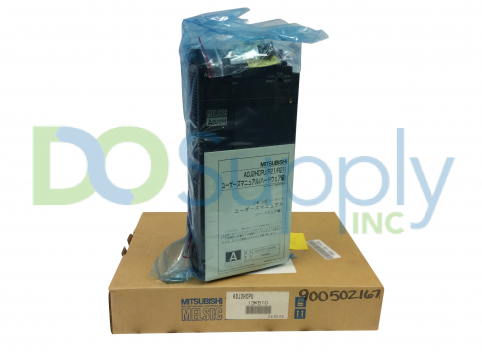
- A0J2HCPU: Input power supply specification: 100…200 VAC.
- A0J2HCPU-DC24: It requires a 24 VDC input power supply.
Key Features:
The MELSEC-A0J2H CPU models outlined above have the following performance specifications:
- I/O Capacity: 336 standard I/O points, and a maximum of 480 I/O points when using A0J2H extension base units.
- Program capacity: up to 8k Steps of main Microcomputer program + main Sequence program
- I/O control method: Selectable Direct mode/Refresh mode
- Sequence instruction processing speed: 1.25µs/step to 2.25 µs/step in direct control mode and 1.25µs/step in refresh control mode
- Total memory capacity for parameters: 32k byte Random-Access Memory
The MELSEC-A0J2H Series is also available with two data link modules:
- A0J2HCPUP21: This module includes an Optical Data Link. It makes use of the SI-200/250 Fibre optic cable for communication.
- A0J2HCPUR21: The module provides a Coaxial Data Link. It uses the 3C-2V or an equivalent 5C-2V coaxial cable for communication.
The two data link modules support 336 standard I/O points and up to 480 I/O points when using A0J2H extension base units. They each feature a communication speed of 1.25 Mbps, and they use Half -the half-duplex bit serial communication method.
Role of Mitsubishi A Series PLCs in Revolutionizing Industrial Automation
A wide array of tools are required to implement industrial automation. Some of these tools include industrial control systems, Robotics, Supervisory Control and Data Acquisition (SCADA), Human Machine Interfaces (HMI), Distributed Control Systems (DCS), etc.
There are many types of industrial control systems used in factory automation, but most manufacturers rely on Programmable Logic Controllers to carry out simple and complex automation tasks; this is due to their faster response times, increased flexibility, real-time operation, simplified programming, and debugging, support for diverse communication protocols, high scalability, precise control, ease of maintenance, built-in safety features, high durability and better reliability even in extreme industrial environments.
As a result, PLCs have become increasingly important as the central components of industrial automation systems. With that in mind, let’s examine the various roles of MELSEC-A Series PLCs in revolutionizing industrial automation.
Monitoring and Data Collection
The MELSEC-A Series PLCs can be adapted to monitor inputs and outputs to and from an industrial machine/equipment and collect data from connected input devices such as switches, sensors, encoders, push buttons, RTDs (Resistive Temperature Devices), thermocouples, and transmitters.
The collected input data, which is usually in the form of electrical signals, can then be processed to be viewed on Human Machine Interfaces (HMIs) as productivity reports, live trends, and other valuable metrics by connecting the MELSEC-A PLCs to Supervisory Control and Data Acquisition (SCADA) systems. This enables factory operators to obtain real-time feedback and interact with the industrial process being monitored, which promotes data-driven decision-making and improved process control.
Process Control and Automation
Essentially, the fundamental role of PLCs in industrial automation is to control and automate industrial processes, machinery, and equipment by sending programmed control functions to connected output devices (e.g., control relays, actuators, motor starters, alarms, electric lamps, and valves) based on the pre-programmed PLC logic and signals obtained from the connected input devices.
They can be programmed and configured to respond accordingly to different inputs or to execute various control tasks in an industrial process or equipment/machinery, such as controlling the flow of fluids in hydraulic systems, activating alarms or warning systems, and controlling the direction and speed of industrial motors.
The MELSEC-A Series PLCs are especially used to monitor, control, and automate a wide range of industrial processes/machinery, including manufacturing processes, production lines, machine tools, assembly lines, conveyor systems, material handling equipment, and more. They offer a compact, user-friendly, cost-effective, and high-speed control solution for a myriad of industrial automation applications.
Examples of Industrial Automation Applications
The high-speed, high-capacity controllers in the MELSEC-A Series are designed with industrial automation in mind. As such, these controllers are capable of satisfying diversified automation needs in a number of industries, including the following:
- Automotive: The MELSEC-A Series controllers improve productivity and enhance flexibility in various automobile assembly lines by providing high-precision motion control, including electronic cam profile and circular/linear interpolation.
- Food and Beverage, Consumer Packaged Goods (CPG): These controllers help realize improvements in different packaging applications, like in high-speed filling processes that require great precision and a very accurate, continuous feed rate.
- Semiconductor Manufacturing: The MELSEC-A Series PLCs solve the high-performance, small-footprint requirements for semiconductor manufacturing with their robust and compact design.
- Renewable Energy: MELSEC-A programmable controllers easily synchronize the management of a renewable energy power plant using plant-wide real-time control and extensive data acquisition, consequently reducing maintenance costs and overall investment.
- Building Automation: By supporting a diverse range of building automation communication protocols, the MELSEC-A Series controllers enhance building security and guarantee the effective application of energy management capabilities in different building systems, resulting in a lower carbon footprint.
- Chemical: You can improve control of chemical manufacturing processes using highly scalable MELSEC-A PLCs that integrate factory automation and process control.
- Quality Control: Various MELSEC-A controllers can easily integrate inspection machine control into automated industrial systems, thereby reducing operational and maintenance costs.
- Flat Panel Display (FPD) Manufacturing: Using a MELSEC-A Series integrated control platform, you can improve the high performance and large data bandwidth requirements common in the manufacturing processes of Flat Panel Displays. An integrated MELSEC-A Series controller and network solution offers enhanced performance and increased flexibility.
- Machining: Increase the operating efficiency, productivity, and overall effectiveness of different industrial machine tools using the scalable control of MELSEC-A Series controllers to support various machining tasks, including drilling, cutting, shaping, planing, boring, grinding, die-sinking, turning, broaching, tapping, and milling.
- Injection Molding: Improve productivity and realize significant reductions in machine operation costs by integrating MELSEC-A PLCs that utilize a user-friendly control platform coupled with highly accurate motion control.
DO Supply Inc. makes no representations as to the completeness, validity, correctness, suitability, or accuracy of any information on this website and will not be liable for any delays, omissions, or errors in this information or any losses, injuries, or damages arising from its display or use. All the information on this website is provided on an "as-is" basis. It is the reader's responsibility to verify their own facts.