What You Need to Know About RS-485 in Industrial Automation
What is RS-485?
RS-485 (Recommended Standard #485), also referred to as EIA-485 or TIA-485 (-A), is a differential signaling standard that defines the electrical properties of receivers and “bused” drivers used to implement balanced multi-point serial communication systems. The standard is jointly developed and maintained by two trade associations: Telecommunications Industry Association (TIA) and Electronic Industries Alliance (EIA).
Serial communication systems implementing the RS-485 standard can be employed effectively in industrial environments characterized by excessive electrical noise. This is because RS-485 networks make use of differential transmission lines that cancel out most of the electromagnetic disturbances gathered up by the RS-485 signals during data transmission.
Also, the standard allows for long-cabling lengths of up to 1200 meters and multi-drop bus systems in which multiple communication devices (RS-485 receivers and drivers) can be connected on the same serial bus. These properties make the RS-485 a useful communication standard in industrial control systems where multiple electronic devices like intelligent sensors, microcontrollers, PLCs, and computers are spread out across a large industrial space and need to be interconnected together for a complete control system.
Features of RS-485
The RS-485 standard, originally known as EIA/ANSI/TIA-485-A-1998 standard, was published in March of 1998 to address the shortcomings of previously developed serial transmission standards – RS-232 and RS-422. Compared to RS-232, RS-485 is more advanced in that it does not only support single device-to-device data transmission, but it also provides a multi-point bus system to connect multiple devices at the same time.
Essentially, the RS-485 standard meets all the specifications of the RS-422 standard, but it’s more robust with an extensive common-mode voltage range (-7V…+12V) and a higher receiver-input impedance. In addition, RS-485 drivers and receivers are backward-compatible and interchangeable with their equivalent RS-422 parts. However, you should not use RS-422 drivers in an RS-485 communication system as they cannot relinquish control of the RS-485 serial bus.
Here are some of the distinguishing features of the RS-485 standard.
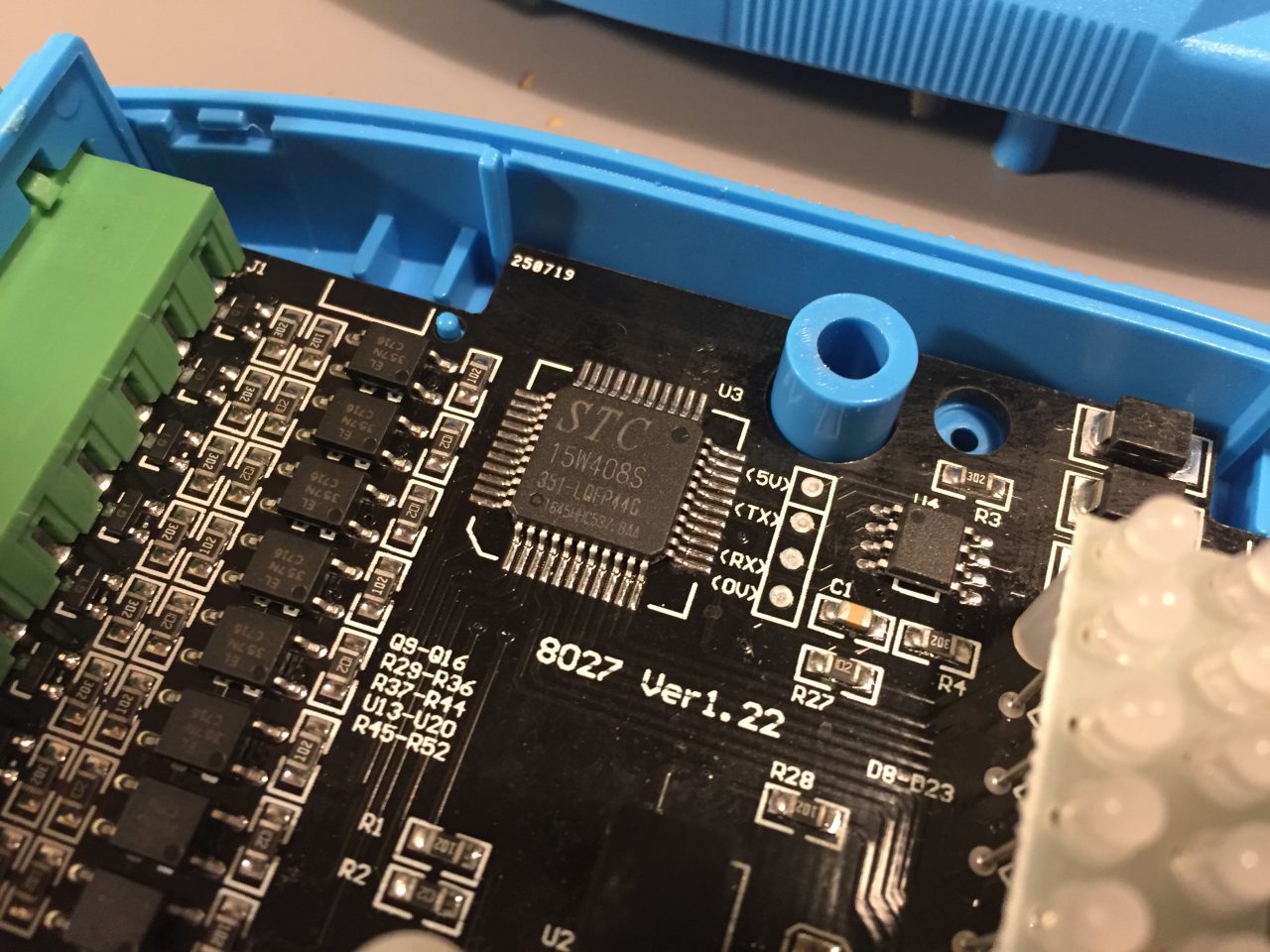
- A Bi-directional, Half-Duplex serial transmission standard, featuring multiple receivers and drivers connecting to one communication bus.
- Receiver Input Sensitivity of ±200mV. This means that an RS-485 receiver can only detect and process signal levels below −200mV or above +200mV.
- Minimum Receiver Input Impedance/ Unit Load: 12kΩ
- Maximum Receiver Input Resistance:12kΩ
- Driver Output Voltage Range : ±5V maximum, and ±1.5V minimum
- Receiver Input Voltage Range: −7V to +12V
- Driver Capacity: 32 Unit Loads; so you can have 32, 12kΩ (minimum input impedance) RS-485 receivers connected in parallel. You can connect any number of receivers to the RS-485 communication bus, as long as the total load being presented to the driver does not exceed 375Ω or rather 32 unit loads – when connected in parallel 12kΩ/32 receivers = 375 Ω. This is because the acceptable maximum load impedance of an RS-485 driver is 54Ω; hence, the RS-485 standard can only allow up to 32 drivers, connected in parallel, in one bus system.
- Driver Short-Circuit Current: 250mA (maximum)
- Absolute Maximum Cable Length: 4000 feet (1200 meters), at which point the data transmission rate is limited to 100kbps (kilobits per second). But the recommended maximum data rate for the RS-485 standard is 10 Mbps (megabits per second), which you can achieve with a cable length of 40 feet (12 meters). Although today’s RS-485 interface circuits (RS-485 transceivers) can operate at data transfer rates of up to 50 Mbps.
Note: The highest working data transfer rate (in bits per second) in the RS-485 standard depends on the characteristics of the connected network devices, installed termination resistors, and cable capacitance.
Where Does the RS-485 Standard Best Fit?
RS-485 is the ideal communication technology in noisy industrial applications that require more than one bus driver/master. Such applications include:
- Process automation in paper mills, brewing processes, and chemical processing plants
- Factory automation such as in metal fabrication and automotive industries
- HVAC systems
- Motor control and motion control applications
- Security systems
How Does RS-485 Function?
As previously stated, RS-485 is a differential signaling standard that supports balanced electrical signaling and multi-point serial communication systems. Being a balanced transmission standard, the RS-485 is implemented using two signal lines (often called A and B) whose voltages are inverse of each other. For this reason, data transmission in an RS-485 communication system is accomplished via a Twisted Pair Cable – insulated strands of two copper wires twisted together.
The use of twisted pair cabling in RS-485 ensures signal integrity in two ways: first, electrical noise from external sources couples equally into the two signal lines of the twisted pair cable as common mode noise; it’s then rejected by the RS-485 differential receiver. Second, since the voltage signals of the twisted pair cable switch inversely to one another, the electromagnetic field emitted by each of the two signal lines is opposite of the other, consequently canceling each other out. This is why RS-485 networks are ideal communication solutions for electrically noisy industrial environments.
With a single twisted pair cable (4 copper wires), an RS-485 communication system can be designed using a Half-Duplex data networking topology where all the network’s receivers and drivers share the same twisted pair cable. In Half-Duplex topology, data can be transmitted in two directions but only in one direction at a time. This means that the RS-485 receivers and drivers in the network are both capable of transmitting and receiving a data signal but not simultaneously–such that, when one device is sending a signal, the other is receiving the signal. At its core, the RS-485 standard makes use of half-duplex communication, with the same two copper wires being used for both reception and transmission but at different times.
If two other copper wires are added, to form two sets of twisted pair cables (4 copper wires), the RS-485 network can be designed using Full-Duplex topology. In this type of topology, the drivers and receivers in the RS-485 network are mixed amongst the two sets of twisted pair cables. The setup allows data transmission in two directions and at the same time, to and from the communication devices. However, in Full-Duplex mode, the RS-485 drivers and receivers are limited to a master-slave communication architecture where the connected devices (slaves) cannot communicate with each other.
The half-duplex implementation requires only one signal pair of two copper wires to acquire the driver and receiver data at different times. On the other hand, setting up a full-duplex topology requires two signal pairs of four copper wires and full-duplex transceivers having different bus access lines for the receiver and transmitter. Also, the full-duplex mode allows an RS-485 node to simultaneously transfer data on one signal pair while receiving different data on the other signal pair.
Both half-duplex and full-duplex RS-485 implementations require some means of controlling the operation of all the network nodes through direction control signals, such as driver receiver-enable control signals for ensuring that only one RS-485 driver is active on the multi-drop bus at any given time. For example, in half-duplex RS-485 implementation, having multiple drivers access the transmission bus concurrently can lead to bus contention, which should be avoided at all times through software control.
How is RS-485 Implemented in Industrial Control Systems?
The RS-485 transmission standard is most popularly used to network Programmable Logic Controllers (PLCs) on factory floors where a lot of electrical noise is present. To implement such networking in industrial control systems, the RS-485 standard is referenced as the physical layer for various higher-level interface standards and proprietary (privately-owned) automation protocols, such as Modbus, DMX-512, Fieldbus, DLT-645, Profibus (Process Fieldbus), and many others. This is because the RS-485 transmission standard does not specify a data communication protocol; it only defines the electrical properties of receivers and drivers connected to a serial bus.
Note: The Open Systems Interconnection (OSI) reference model seeks to define the different layers of a networking system from the Application layer(top-most), down through the Presentation layer, Session layer, Transport layer, Network layer, Data Link layer, and lastly onto the bottom-most Physical layer.
Let’s look at how the RS-485 standard is used in Modbus and Profibus protocols to implement industrial control systems for process/factory automation.
Modbus RS-485
One of the most widely used industrial automation protocols in the market today is Modbus. Modbus is a data communication protocol initially developed and published by Modicon® in 1979 to be used with the company’s PLCs. It’s simply a method of transmitting information between electronic devices that are connected to networks or buses over Serial lines, Ethernet, and increasingly using Wireless technologies.
Since the Modbus protocol is based on a request-response communication model, Modbus devices communicate using a Client-Server (previously, Master-Slave) technique in which only one device (the Client/Master) can initiate the queries (transactions). The other devices (Slaves/Servers) respond by providing the requested information to the Master/Client, executing the command specified in the query, or performing any other possible function. This entire setup allows manufacturing facilities to use Modbus communication networks to control their machinery/processes remotely and implement automation using industrial controllers such as PLCs.
Most Modbus serial communication networks use the RS-485 standard as the network’s physical layer, due to the standard’s advantages of higher data transfer speeds, longer transmission distances, and support for multiple devices on a single network/bus. In such implementations, the Modbus standard defines the type of communication protocol–serial protocol– while the RS-485 standard defines the signal level of that protocol. In other words, the RS-485 standard defines the physical level of the electrical signals between the Modbus Master and the Slaves, as well as the effectiveness of the wiring enabling the data transmission.
Hence, the term Modbus RS-485 denotes the communication protocol being used in an industrial control system along with the protocol’s ability to communicate effectively by the RS-485 serial transmission standard. Modbus RS-485 is a popular protocol in process automation because it allows the integration of various devices using the same transmission standard (RS-485) on the same bus, thereby eliminating the need for multiple interfaces on the host (master/client) while querying multiple connected devices (slaves/servers). Normally, one RS-485 multi-drop serial bus can facilitate a maximum of 127 Modbus slave devices.
Use of RS-485 in Profibus
Profibus, or rather, Process Field Bus, is a Fieldbus communication standard used in process automation. In general, the term Fieldbus refers to all the network protocols used in industrial machines and automation systems to provide real-time, closed-loop control between intelligent field devices (e.g. sensors and actuators) and host/master systems such as PLCs, handheld HMIs, and industrial PCs. Also, like Modbus, Profibus is a master-slave bi-directional communication protocol but with an extra token-ring protocol that allows for multiple masters–each Profibus node can be a master or a slave. As a bi-directional network, Profibus works by one device, the master, sending a data request to a slave device, and the slave responds by providing the requested data.
Profibus networks used in industrial automation are an extension of the RS-485 standard. In such applications, the Profibus protocol provides the overall description of the control system while the RS-485 is utilized as the standard for the physical layer of the network supporting the two communication standards. In addition, since the Profibus communication protocol is built upon an RS-485 transceiver it can only support a maximum of 32 nodes (master and slaves), but with the option of expanding the network nodes by use of repeaters up to the protocol’s maximum limit. This is a major advantage for SCADA (Supervisory Control and Data Acquisition) systems that require the interconnectivity of multiple devices distributed over an extensive geographical area.
Factors Limiting RS-485 Data Rate
Outlined below are the factors affecting the rate at which one can reliably transmit data in the RS-485 standard.
- Cable Length: The longer the length of the twisted pair cable utilized in the RS-485 network, the lower the maximum data transfer rate. This is because, at a specific frequency, the RS-485 signal is attenuated (reduced in strength) by the twisted pair cable as a function of length.
- Cable Construction: Adding shielding to an RS-485 data transmission cable enhances immunity against electrical noise, thereby increasing the data transfer rate for a given distance. Cat6 24AWG, Cat5e, and Cat5 shielded cables are very common types of twisted pair cables used in RS-485 communication systems.
- Receiver Input Impedance: A considerably low receiver input impedance limits the number of receivers that an RS-485 driver can handle.
- Cable Characteristic/Surge Impedance: This is the ratio of voltage amplitude to current amplitude of a single-direction wave propagating along the RS-485 transmission line. Distributed inductance and capacitance slow transmission edges, consequently reducing the noise margin. On the other hand, a distributed resistance reduces the level of the RS-485 signal directly.
- Driver Output Impedance: A very high driver output impedance reduces the driver’s capability.
- Noise Margin: This is a quantitative measure of noise immunity and it indicates the amount by which the data signal being transmitted exceeds the specified threshold. It’s meant to ensure that data transmission lines are functioning properly within the specified operating conditions. A higher value of noise margin equates to a better RS-485 signal quality.
- Termination: A long twisted pair cable can function like an RS-485 transmission line. Terminating such a cable with its surge impedance reduces signal reflections and increases the attainable data rate.
- Driver’s Slew Rate: This is the maximum rate of change of a driver’s output voltage per unit of time; it’s given in volts per microsecond. Lower slew rates (slower edges) allow data transmission over long twisted pair cable lengths, but they significantly reduce the maximum achievable data transfer rate.
DO Supply Inc. makes no representations as to the completeness, validity, correctness, suitability, or accuracy of any information on this website and will not be liable for any delays, omissions, or errors in this information or any losses, injuries, or damages arising from its display or use. All the information on this website is provided on an "as-is" basis. It is the reader's responsibility to verify their own facts.