Stratix 5900 vs. 5700: Which One Belongs in Your Panel?
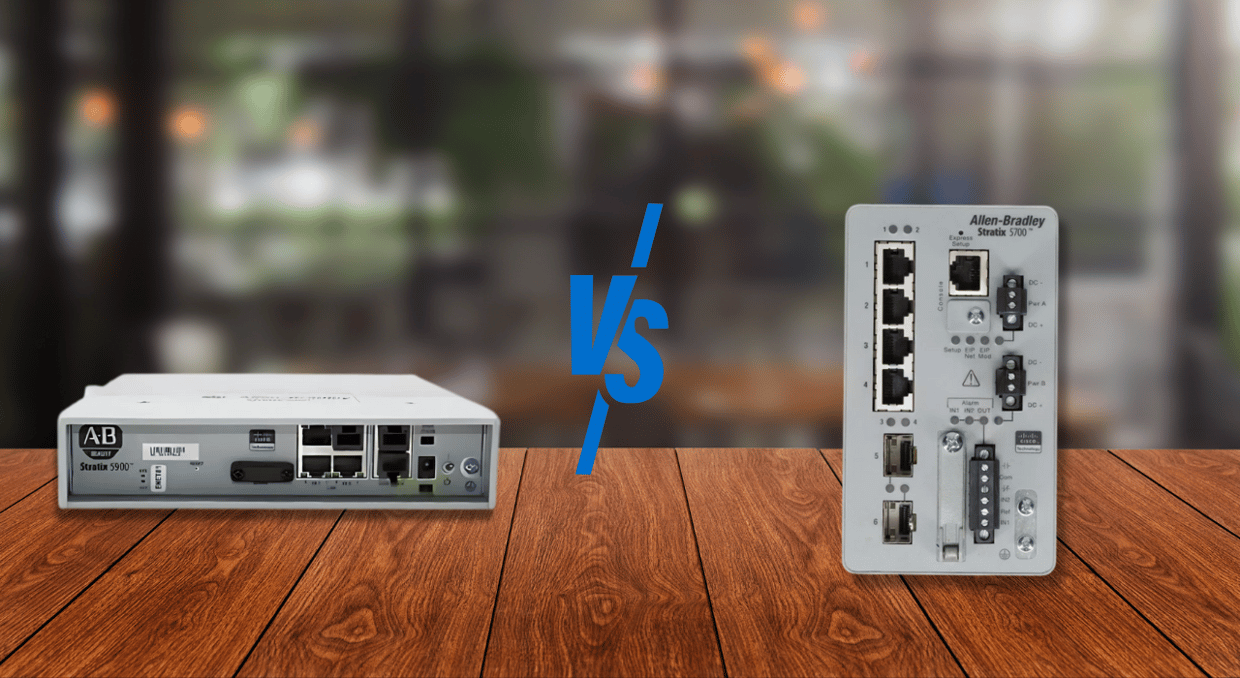
In any industrial setting, getting two machines to talk to each other is only half the battle. The real challenge is keeping that conversation organized, secure, and flowing in the right direction. This is where networking hardware comes into play. If you’re already invested in the Allen-Bradley environment, then the Stratix family might be familiar to you.
Like other families of automation tech from AB, the Stratic models serve different purposes. While the 5900 and 5700 may sound like cousins, they’re built for entirely different jobs. While the 5700 keeps online traffic flowing smoothly, the 5900 stands guard to keep out bad actors from entering the network. That being said, which one belongs on your panel?
An Overview of the Stratix 5700
Starting with our industrial-grade managed switch, the Stratix 5700 is designed to control the flow of traffic in industrial settings. It’s designed to make sense of the chatter between drives, controllers, and operator interfaces. With configurations ranging from six to twenty ports, support for copper and fiber, and models that include PoE or NAT capabilities, it’s a surprisingly flexible piece of hardware that quietly keeps everything running.
At its core, the 5700 is designed to allow you to segment devices, prioritize critical packets, and even reroute traffic if a cable is unplugged somewhere in a ring. The switch can even play nicely with both IT and OT teams thanks to built-in Cisco IOS and support for Device Level Ring (DLR), all with the added benefit of staying resilient to bumps, heat, and vibrations.
Features and Capabilities of the Stratix 5700
The Stratix 5700 is the rugged managed switch ready to be at the heart of your automated system. While the Cisco IOS is a foundational feature, many more features come with this switch:
Device-Level Ring (DLR) Support
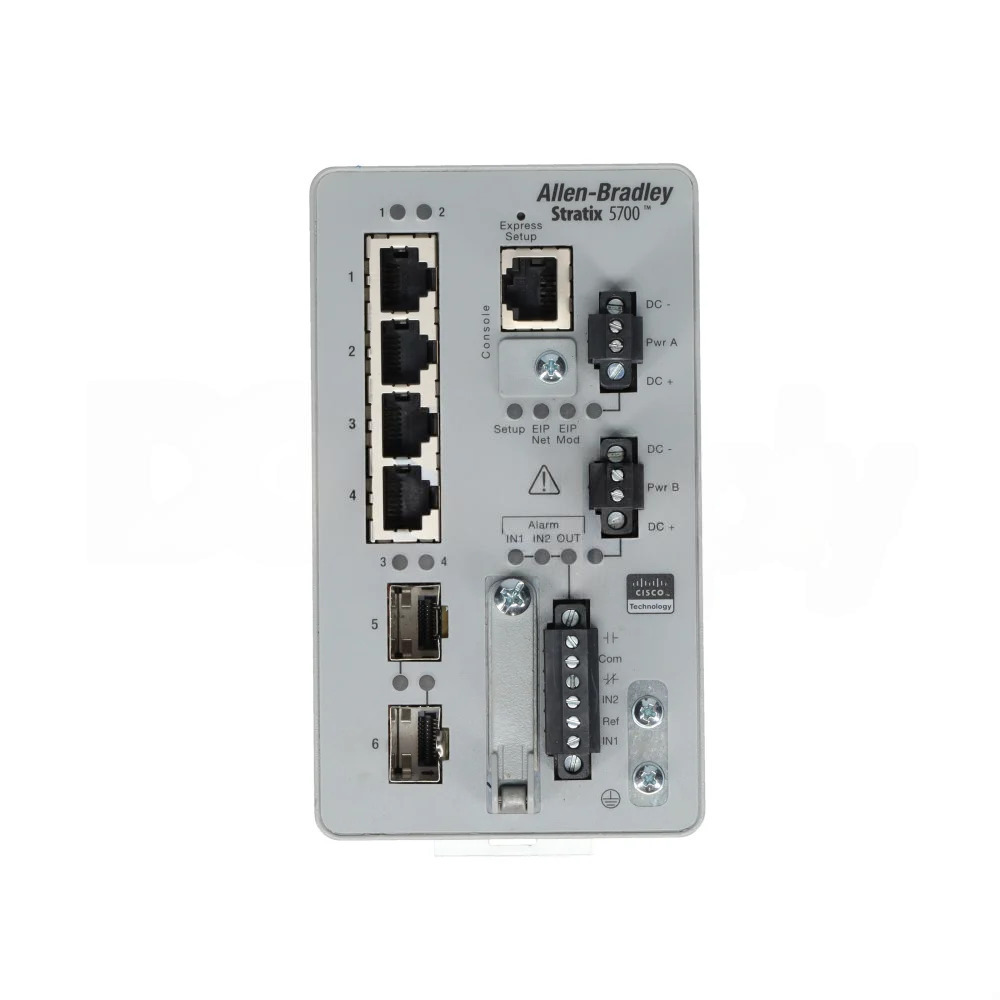
As mentioned earlier, the Stratix 5700 includes native support for DLR on most models, enabling it to function as either a node or a supervisor in a ring topology. This means if a cable gets severed, the switch detects the break and immediately reroutes traffic, keeping communication flowing with minimal downtime. It’s fast, automatic, and invaluable for motion systems or safety-critical equipment.
Network Address Translation (NAT)
Certain models of the 5700 support 1:1 NAT, which is a lifesaver for OEMs. Instead of rewriting IP addresses for every new machine you deliver, Network Address Translation (NAT) lets you maintain consistent internal addressing. The switch handles remapping at the boundary, making machine integration into plant-wide networks faster and more scalable.
Port and Traffic Control
VLANs, ACLs, and QoS are all there. You can isolate devices, prioritize control traffic, and block unauthorized access at the port level. For applications that rely on deterministic behavior or strict security zones.
Flexible Hardware Options
From 6-port models to 20-port powerhouses, there’s a 5700 for nearly every footprint. Some versions offer:
- Fast Ethernet or Gigabit ports
- PoE to power field devices
- Redundant power inputs
- Conformal coating for harsh environments
- CIP Sync support (on select models)
- SD card support for configuration backups and quick replacements
The Stratix 5900
Not every network challenge happens inside the control panel. Sometimes the biggest risks come from outside, whether it be from remote users, corporate traffic, or unknown devices attempting to gain access. This is where the Stratix 5900 steps in. While the 5700 was a hardened switch, the 5900 is an industrial router equipped with robust cybersecurity technology. With built-in firewalls, VPN capabilities, deep packet inspection, and Cisco IOS under the hood, the 5900 is Allen-Bradley’s answer to the increasing overlap between IT and OT.
What the Stratix 5900 is Built to Do
Unlike traditional routers that reside in data closets, the Stratix 5900 is designed to withstand the vibrations, heat, and even some shock associated with modern factories. It’s designed to sit between plant-floor devices and everything else, managing traffic between local controllers and remote services, enterprise systems, or even external vendors. What makes it especially suited for the job is its balance of rugged hardware, Cisco routing muscle, and deep industrial compatibility.
Zone-Based Firewall and Deep Packet Inspection
The 5900’s integrated firewall is built for zone-based control. That means you can define security policies based on the network zone (machine, plant, or enterprise), and use packet inspection to examine the traffic in more detail. You can block or allow traffic based not only on origin, but also on the type of application attempting to use it.
VPN Capabilities for Secure Remote Access
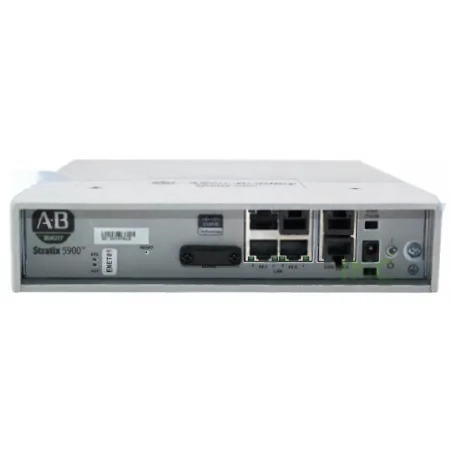
Whether you’re supporting a remote maintenance team or providing access to corporate servers, the 5900 supports advanced VPN configurations, such as IPsec and Virtual Tunnel Interfaces (VTI). You can set up encrypted tunnels between remote devices and the plant floor, all with options for multi-factor authentication and dynamic routing across the VPN.
Routing Power for Complex Architectures
The Stratix 5900 supports a full range of routing protocols, including:
- Static routing
- RIP
- OSPF
- EIGRP
This allows it to serve as a dynamic gateway between isolated machine networks and broader plant or enterprise backbones. It can also perform NAT functions similar to those of the 5700, but with enhanced routing intelligence and flexibility.
Industrial-Grade Build and Mounting
It’s DIN-rail mountable, fanless, and rated for –25 to 60 °C operation. It comes with:
- 4 Fast Ethernet LAN ports
- 1 Gigabit WAN port
- Serial console and AUX support
- Onboard crypto acceleration
- Secure Digital (SD) config storage
- AC power input with lock
- Grounding lug for industrial cabinets
Security-First Design
The 5900 also includes features like:
- One-step router lockdown
- Intrusion Prevention System (IPS)
- TACACS+ / RADIUS authentication
- Content filtering
- Secure remote access with TLS 1.2
- Compatibility with Cisco security infrastructure
All this makes it suitable not only for internal security but also for connecting to third-party services or enterprise cloud applications without compromising the integrity of the factory floor. We have much more detailed breakdown of the Stratix 5900s host of security features right here.
Better Together in the Same Network
While it is easy to ask, “Which one do I need? The switch or the router?” the better question is, “Where does each one go?” Because in a well-designed industrial network, you’re probably going to want both.
The Stratix 5700 acts as the internal organizer, residing inside machine panels, on the plant floor, or anywhere devices need to communicate with each other with as little delay as possible. It handles segmentation with VLAN and supports DLR for fault-tolerant ring topologies.
On the other hand, the Stratix 5900 inspects, filters, and encrypts traffic between isolated machine networks and all other traffic. Think of it as the gateway between OT and IT, with all the access control, authentication, and deep packet inspection tools needed to enforce boundaries without compromising productivity.
Here’s a common setup:
- Multiple machines, each with a Stratix 5700, manage local device traffic and provide VLAN segmentation or NAT translation.
- These switches report upstream to a Stratix 5900, which acts as the secure bridge to enterprise servers, remote support staff, or cloud platforms.
- The 5700 keeps things organized. The 5900 keeps things safe.
Together, they form a layered defense and performance model: the 5700 ensures network efficiency and manageability, while the 5900 adds the critical security and routing intelligence to protect and extend that network into larger systems.
If the choice is still unclear, we invite you to give us a call, and we can help you select the right service equipment. We also carry a wide range of Stratix 5700 and 5900 models in stock, ready to be shipped and backed by our two-year warranty. Contact us today, and we can help secure your factory network.
DO Supply Inc. makes no representations as to the completeness, validity, correctness, suitability, or accuracy of any information on this website and will not be liable for any delays, omissions, or errors in this information or any losses, injuries, or damages arising from its display or use. All the information on this website is provided on an "as-is" basis. It is the reader's responsibility to verify their own facts.