Maximizing Your Industrial Automation Efficiency with PLCs, HMIs, Drives, and Motors
Industrial Automation is the use of automation devices and different technologies such as robotics, computer software, and communication systems to control industrial processes and machinery without significant human input. An extensive range of tools is required to implement industrial automation including control systems that integrate different automation devices like PLCs, HMIs, Drives, and Motors
Programmable Logic Controllers (PLCs) are used to control and monitor industrial machinery/processes. Human-Machine Interfaces (HMIs) provide a user-friendly interface that connects plant operators to industrial controllers for machines, systems, and other devices. Drives control the torque and speed of industrial motors, while motors are used in industrial automation systems to convert electrical input energy into mechanical output energy.
Industrial automation is increasingly becoming an essential part of modern-day manufacturing and production processes. Therefore, an understanding of its various components and how they work together can enable businesses to maximize their industrial automation efficiency. In this article, we’ll discuss the role of PLCs, HMIs, Drives, and Motors in industrial automation.
Role of PLCs in Industrial Automation
Programmable Logic Controllers are ruggedized computing devices that are pre-programmed to implement automatic control operations in industrial processes. A typical PLC system is made up of a Central Processing Unit (which includes a processor and memory unit), programming terminal, power supply, and input/output (I/O) modules. The processor is a solid-state device designed to perform a comprehensive range of processes, machine tools, and production-control functions; it acts as the brain of the PLC system.
In industrial automation, PLCs usually have three main functions:
- Monitoring and controlling automated industrial processes.
- Performing tasks related to testing and measuring in complex manufacturing applications.
- Executing process-type control functions, such as heat extraction, heat addition, and conditioning tasks in HVAC systems.
To carry out the aforementioned functions, each Programmable Logic Controller is interfaced with sensors and/or other input devices such as relays, push-buttons, thermometers, switches, etc., through which it receives the necessary input data for its processor to make logic-based control decisions and subsequently output control commands to a connected electrical or mechanical system (output device), thereby completing a specific automation task in an industrial process. Note, the control functions sent to the connected output devices (a wide range of actuators) are based on the PLC’s programmed logic and the signals received from the connected sensors/input devices.
PLCs may function as standalone control units that can continuously monitor and control a specific industrial process or a given machine function. They can also be networked through various communication interfaces to automate an entire manufacturing/production line by carrying out sequential and repetitive processes. This flexibility allows PLCs to be used in numerous applications for process and manufacturing control. Also, with the ongoing Industrial Internet of Things (IIoT) revolution, PLCs are now becoming popular in many industrial automation applications, including:
- Smart manufacturing
- Automated food processing systems
- Automated automobile production
- Robotic automation systems
- Automatic control systems for machine tools
- Automating processes in steel, paper, and glass industries
How Do PLCs Maximize Industrial Automation Efficiency?
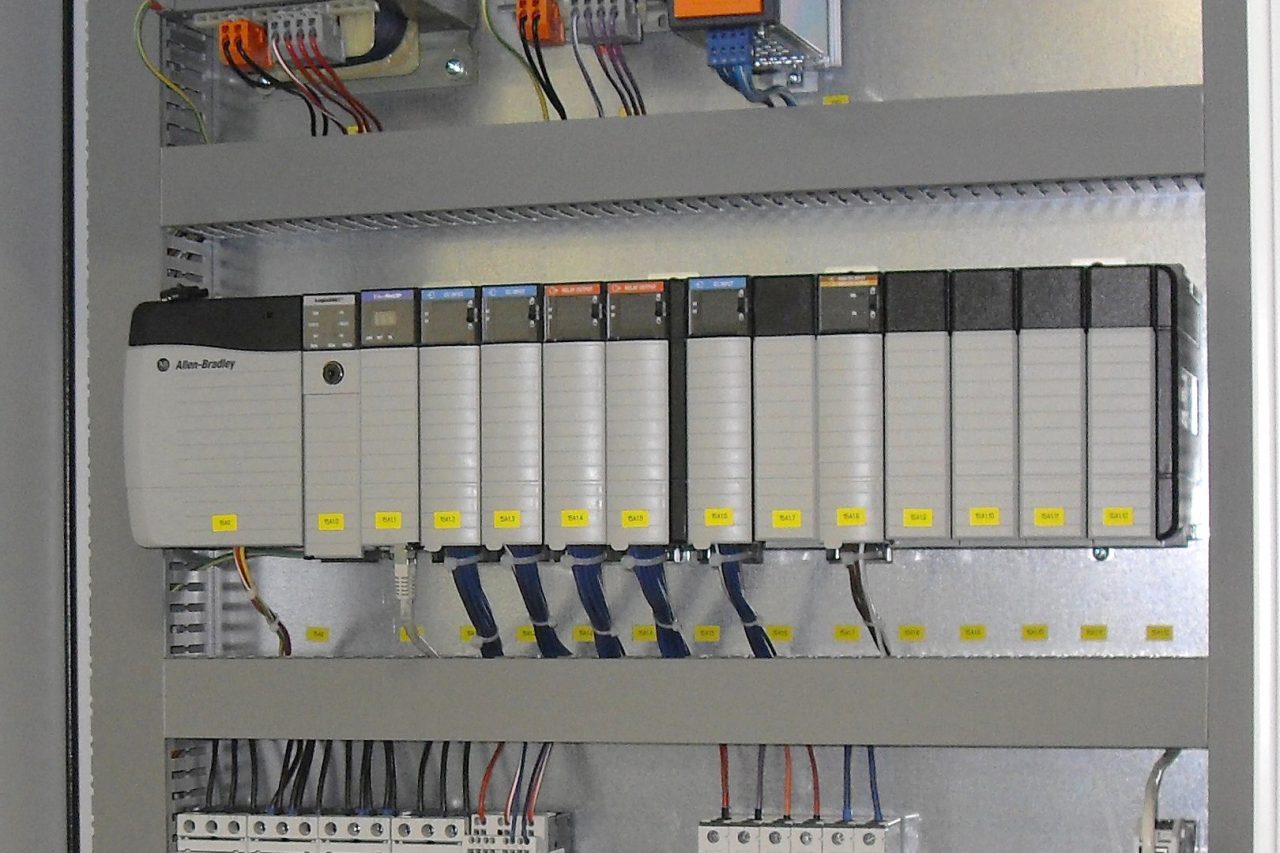
The focus of industrial automation is to control automation devices that run advanced functionalities (including machine reconfiguration and IIoT connectivity) while facilitating the ability of human operators to make informed control decisions about industrial machines or operations. Hence, an efficient automated industrial facility aims at increasing system productivity and the quality of products. Present-day industrial automation highly depends on real-time feedback from process machines, operational data, and the complex interconnections between different digital devices found in a factory setup. This means that PLCs play a critical role in the effectiveness of industrial automation systems.
First, PLCs improve the performance of manufacturing plants at the control level by collecting and sending back information from I/O devices at the field level and sometimes transferring the collected data to supervisory level control systems, such as SCADA (Supervisory Control and Data Acquisition) and Historian. Some advanced PLC systems do perform supervisory-level control tasks themselves. Second, PLCs assist in minimizing human decision-making efforts to gain higher industrial automation efficiency. In essence, PLCs are often used in industrial automation systems to increase system performance, stability, and reliability, whilst reducing the need for human intervention and the chances of human error.
Maximizing Industrial Automation Efficiency with HMIs
A Human-Machine Interface (HMI) device is a combination of HMI software and suitable hardware that enables communication and interaction between human operators and industrial machines, or production systems. HMIs translate complex operational data into accessible information for plant operators, enabling better control of production processes and other applications.
Initially, HMIs were simply developed to replace hard-wired indicator lights and pushbuttons in controlling industrial machines and processes. These early HMIs did not include graphic representations or augmented reality, and neither did they provide operational insights to human operators. Also, they were confined to plant floor control panels or centralized control rooms, which required operators to be physically present at the HMI location to access information on plant operations.
However, today’s HMIs are not just programmable replacements of hard-wired indicator lights and pushbuttons that simply digitize and centralize data for viewers. They are easy-to-understand visual displays that give meaning and context to near real-time plant operation information and which provide the right insights on how to effectively run automated industrial processes. They present that information and the insights to human operators whenever and wherever they need it, even on the factory floor when they are working on and around production equipment. This enables the operators to make informed control decisions that help to run production processes more safely and profitably.
In addition, the advanced capabilities of modern-day HMIs enable plant managers and supervisors to do more than just simply control machines or processes. Here are some ways how HMIs assist in maximizing the efficiency of industrial automation:
- They provide new opportunities to increase the efficiency of automated production systems and improve the quality of both products and services.
- They can function as powerful edge computers that collect and process plant operation data in real time to support state-of-the-art automation strategies such as predictive maintenance.
- As mobile automation technologies, HMIs give plant operators access to production information and useful insights from wherever they may be working (within or even outside the manufacturing facility).
- They feature powerful networking and processing capabilities required to provide different levels of information to workers anywhere in a manufacturing facility. For example, they can provide access to control-level information from anywhere in the facility, including at the supervisory or enterprise level.
- They enable operators to quickly and easily spot production problems and address them accordingly.
- They connect machines, software applications, and human operators across different locations.
- HMIs are open technologies that allow users to select the hardware, software, networks, and data sources that best match their application requirements.
By leveraging the above-mentioned capabilities of HMI, plant operators can access important plant information displayed in form of charts, digital dashboards, or graphs, view and manage process control alarms, and connect with MES (Manufacturing Execution System), ERP (Enterprise Resource Planning), and SCADA systems, all through a single console.
Use of Drives and Motors in Industrial Automation
The most widely used prime movers in industrial automation applications are electric motors–an electric motor converts magnetic and electrical energy into mechanical motion. In most of these applications, the motors are provided with various control equipment by which their operating conditions and characteristics – voltage, armature current, torque, and speed – can be adjusted to different load requirements.
The combination of an electric motor, control equipment, and a power transmission shaft constitutes an electric drive. Electric drives are used to control the output torque and speed of AC & DC motors present in automated industrial machines/systems. Let’s look at the various types of electric motors and drives that play a key role in maximizing the efficiency of industrial automation.
Electric Motors
Electric motors are the lifeblood of industrial automation, they make automated systems run. While every automated industrial system is different, there is just a wide array of motor technologies, standards, designs, form factors, sizes, and brands to fit each application. This makes the motor selection for industrial automation purposes an important process.
Discussed below are the various types of motors used to run industrial automation systems.
A) AC Motors
AC motors convert alternating current (AC) electrical input energy into mechanical output power. At the basic level, AC motors consist of two essential parts: (i) Outside Stator with coils (windings) that are provided with alternating current to generate a primary rotating magnetic field, and (ii) Inside Rotor that generates a secondary rotating magnetic field; the rotor is connected to the motor’s output shaft.
An AC motor operates by rotating the output shaft across the generated magnetic fields to create voltage, which is then converted into mechanical motion used to run automation systems. If the shaft is rotated in a closed magnetic field, then current is created. Based on the principle of operation, AC motors are classified into two main types: Induction Motors and Synchronous Motors, which are further categorized as either single-phase or three-phase motors.
The two types of AC motors (Induction ad Synchronous motors) are a great source of power for most industrial automation systems because of several reasons, including:
- Efficiency: They are characterized by high speeds and can generate higher torque outputs, which enables them to operate continuously without overheating.
- Brushless: Brushless AC motors have a high power-to-weight ratio, higher speeds, nearly instantaneous control of torque and speed (RPM), low maintenance, and a longer lifespan. They also operate more efficiently with negligible or no power loss, which is normally a problem of brushed motors because of increased friction caused by the motor brushes.
- Improved Speed Control: The speed of AC motors is readily controlled by adjusting the frequency of the motors’ voltage supply.
- Simple Construction: They consist of just one moving part, the rotor. Also, they are available in various sizes and shapes with different power ratings.
- Quiet Operation: When in operation, AC motors produce a very low humming sound.
Essentially, the high flexibility and efficiency of AC motors make them ideal power solutions for an extensive range of industrial applications including automated conveyor equipment, pumps, blowers, fans, food & beverage machines, packaging operations, and many other systems that require constant, adjustable, or variable speed control.
B) Brushed DC Motors
Brushed DC motors convert direct current (DC) input electrical energy into mechanical motion. They consist of four main components: (i) Rotor, (ii) Stator (with Permanent Magnets), (iii) Brushes, and (iv) Commutator. These motors function by having the rotor coil rotate around the permanent magnets in the stator. The rotation of the coil makes the contact between the brushes and the commutator to alternate, thereby switching the flow of current through the rotor.
As internally commutated electric motors, their operating principle enables them to produce high torque during both deceleration and acceleration, making them ideal power sources for industrial automation systems that require high peak and simple run-off of speed controllers, such as in packaging, dispensing, and some robotic applications. However, they require periodic maintenance, and they have a lower lifespan due to mechanical wear and tear on the commutator and brushes.
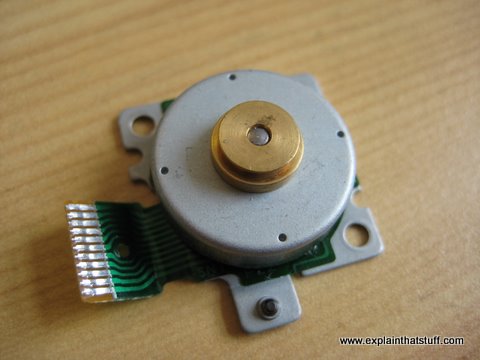
C) Brushless DC Motors
Brushless DC motors operate similarly to brushed DC motors, but they don’t use brushes to produce an electromagnetic field. Also, instead of their permanent magnets being on the outside stator as with the brushed DC motors, brushless DC motors have their permanent magnets on the interior rotor.
They are more efficient, quieter, and have longer lifespans compared to brushed DC motors. In addition, they’re able to operate continuously with negligible or no heat output. These benefits make them ideal for hazardous industrial environments that contain grease, oil, dust, and other contaminants.
D) Servo Motors
Servo motors are specially designed to drive mechanical systems with integrated feedback devices such as resolvers or encoders. They provide highly precise closed-loop control for motor speed, position, and output torque, perfectly suiting them for high-precision industrial systems such as robotic automation systems and automated production lines. In addition, these motors feature quiet operation, high acceleration, and a high torque to inertia ratio comparable to that of AC motors.
Inherently, servo motors are highly accurate, efficient, and reliable solutions for a considerable number of industrial automation applications including robotics, automated forming and metal cutting machines, CNC machining, printing presses, conveyor belts, food and beverage processing, as well as packaging applications.
Electric Drives
Electric drives control the speed, output torque, and other motion properties of AC & DC motors by regulating the voltage and frequency input to the motors. If the drive regulates both the input frequency and voltage, then the torque of the motor is controlled. On the hand, if the drive regulates only the voltage input to a motor, then the speed of the motor is controlled. A typical drive system consists of a motor, control unit or controller, an electrical power supply, and a powerful processor and electronic converter used to control voltage flow to an electric motor to obtain variable speed.
Many industrial applications require variable-speed electric motors, which makes electric drives an integral part of industrial automation. As the drives provide precise motor control, the speeds of the motor can be ramped up and down or be maintained at a specific speed. The obvious benefit of this is enhanced energy savings because drive-controlled motors only use the necessary amount of energy, rather than when they are running at a constant speed. Other benefits include increased motor longevity, elimination of many expensive mechanical drive components, reduced risk of motor damage during start-up and when stopping, improved safety, and so on. All these benefits help maximize the efficiency of industrial automation.
Examples of electric drives used in industrial automation applications include:
A) AC Drives
AC (Alternating Current) drives control the speed of AC motors to increase the efficiency of motor-driven equipment, minimize energy usage, enhance process control, reduce mechanical wear and tear of motors, and optimize the various applications that are powered by such motors. They are widely used in automated manufacturing facilities to regulate and control rotating machinery and equipment such as conveyors, fans, pumps, and machine spindles. AC drives are further divided into:
- Variable Frequency Drives (VFDs): They precisely control the speed, output torque, and direction of induction or synchronous AC motors by varying the supply voltage and frequency input to the motors. This increases the efficiency of the AC motors.
- Variable Speed Drives (VSDs): They control the torque and speed of AC motors by converting a fixed frequency and electrical supply voltage to a variable frequency and voltage output. This allows precise control of the motor speed to accurately match the load requirements, greatly improving system performance.
- Adjustable Speed Drives (ASDs): These drives control the operating speed of AC motors by varying the electrical frequency input to the motors.
B) DC Drives
DC (Direct Current) drives are motor-speed control systems that convert an AC input supply into the needed DC input using a rectifier circuit (based on thyristors and diodes) to control the operating speed of DC motors. Common DC-drive industrial applications include control of automated material handling, machine spindles, hoists, elevators, movement of axes on wire-drawing machinery, paper-web handling, and extruding applications.
C) Stepper Motor Drives
Stepper motor drives are open-loop systems designed to accept digital step and direction inputs provided by a motion controller or an indexer-programmable pulse generator. These drives are specifically designed to control stepper motors, which can continuously rotate with a remarkable degree of precise position control, even without a feedback control loop.
D) Servo Drives
Servo drives, also known as servo amplifiers, are used to control the torque output, speed (velocity), and/or position of servo motors. They receive a command signal from a host controller and compare it with the feedback signal provided by a servomechanism, so that it may deliver a given amount of voltage to the connected servo motor and correct any existing deviation from the provided command signal to produce the required motion.
DO Supply Inc. makes no representations as to the completeness, validity, correctness, suitability, or accuracy of any information on this website and will not be liable for any delays, omissions, or errors in this information or any losses, injuries, or damages arising from its display or use. All the information on this website is provided on an "as-is" basis. It is the reader's responsibility to verify their own facts.