Stratix 5000 Series vs. The Competition
Choosing a network switch for your industrial operation is a bit like picking the right tool for a DIY project. You know what needs to be done, but grabbing a hammer when you really need a screwdriver isn’t going to get you very far. The key is finding the right tool for the job, and with the Stratix series, Rockwell Automation has built a toolbox that’s hard to ignore.
Whether you’re looking for the straightforward reliability of the Stratix 5700 or the security-first approach of the Stratix 5900, each switch has a role to play. The question is, how do these tools compare to others in the hardware store? And, more importantly, which one will help you get the job done?
Before you start building, let’s dive in and see which tool fits your industrial network best.
Stratix 5700: The Reliable All-Rounder
If you had to pick a go-to switch for handling most industrial network challenges, the Stratix 5700 would be that trusted multi-tool you always keep within reach. Designed for small to medium-sized networks, this switch is all about flexibility without overcomplication, making it a standout in environments where reliability and ease of use are essential.
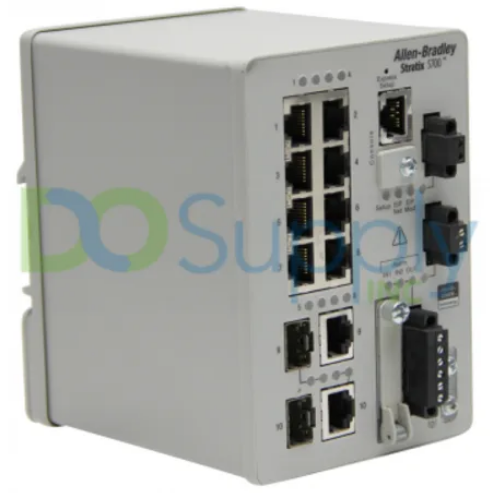
At its core, the Stratix 5700 functions as a Layer 2 and Layer 3 switch, which means it handles both basic and advanced routing capabilities. It’s ideal for operations that need a solid backbone to manage data traffic without bottlenecks. Whether you’re dealing with machine-to-machine communications on a factory floor or maintaining data flow in a distribution center, the 5700 adapts to different demands without missing a beat.
Key Features and Part Numbers
One of the Stratix 5700’s strengths is its scalability. Models like the 1783-BMS10CGN and 1783-BMS20CGP offer flexibility in terms of port density, ranging from 6 to 20 ports. But what makes these models especially useful is their mix of Gigabit and Fast Ethernet ports, which, in certain models, provide up to 16 Gigabit Ethernet ports. This means you can handle everything from simple I/O communication to bandwidth-heavy video streams without sweating over throughput.
Another big advantage is its support for Power over Ethernet (PoE). Part numbers such as the 1783-BMS10CGP offer PoE+ capabilities, which can provide up to 30W per port, a feature that’s invaluable when powering IP cameras, access points, or VoIP phones directly from the switch. Not having to run separate power cables simplifies the installation process and reduces costs, which is especially handy in harsh industrial environments where power management can be a logistical headache.
The 1783-BMS20CGP takes things a step further by combining 16 Gigabit Ethernet ports with four dual-media SFP combo ports, which offer both copper and fiber connectivity. This feature makes the 5700 highly adaptable, allowing you to connect long-distance fiber optic cables for extended networks while still using traditional copper for local connections.
Performance and Environmental Durability
The Stratix 5700 isn’t just about port flexibility; it’s also built for tough environments. With an operating temperature range of -40°C to 75°C and certifications like ATEX, CE, and UL, the 5700 can withstand the harshest industrial conditions, from freezing cold warehouses to hot production floors. This ruggedness makes it a preferred choice in industries like oil and gas, manufacturing, and water treatment, where durability isn’t just a nice-to-have; it’s a necessity.
Additionally, the 5700 is Conformal Coated to protect against dust, moisture, and other environmental contaminants that could otherwise shorten the lifespan of traditional networking equipment. The coating acts as an extra layer of defense, particularly in settings where exposure to harsh chemicals or particulate matter is common.
Protocol Support
In terms of communication protocols, the Stratix 5700 offers extensive support for industrial protocols such as CIP (Common Industrial Protocol) and Modbus TCP. This makes it easy to integrate into existing automation systems, as the switch can communicate seamlessly with PLCs, HMIs, and other industrial devices. It also supports QoS (Quality of Service) and IGMP snooping, ensuring that critical data like control signals or time-sensitive information get prioritized on your network.
Competitor Comparison: Cisco IE-2000 and Hirschmann RS20
When comparing the Stratix 5700 to its competitors, two main contenders come to mind: the Cisco IE-2000 and the Hirschmann RS20. Each offers a solid set of features, but there are clear distinctions when looking at flexibility, ease of use, and cost-effectiveness.
The Cisco IE-2000 is often seen as a robust choice in the industrial networking market, with its own strong emphasis on durability and high performance. It’s highly configurable, with Gigabit Ethernet and Fast Ethernet options, as well as PoE support. However, where the Cisco IE-2000 falls short compared to the Stratix 5700 is in its ease of use and integration within industrial settings. Cisco’s switches often require more extensive network expertise to configure and maintain, making the learning curve steeper, especially for teams without dedicated IT resources. The price point for Cisco’s industrial switches can also be higher, which may not align with the budget constraints of smaller operations. In contrast, the Stratix 5700 offers easier deployment, particularly for users already familiar with Rockwell Automation’s ecosystem, and it’s more cost effective when factoring in its scalability and PoE capabilities.
On the other hand, the Hirschmann RS20 excels in ruggedness, with strong environmental protection features. It’s highly customizable and can handle demanding industrial environments similar to the 5700. However, it lacks the port density and Gigabit support that the Stratix 5700 provides, making it less suitable for bandwidth-intensive applications. Additionally, while Hirschmann is known for its long-standing reputation in industrial automation, the RS20 doesn’t offer PoE support, which can be a significant drawback for facilities that rely on IP cameras, VoIP phones, or other PoE-powered devices. The Stratix 5700’s versatility, with its mix of Gigabit Ethernet ports and PoE+ capabilities, provides a clear edge for applications that require more advanced connectivity options.
In terms of overall value, the Stratix 5700 shines when you need a switch that balances ease of deployment, cost-effectiveness, and solid performance. It’s rugged enough to handle demanding environments yet flexible enough to integrate into a wide range of network architectures without the high costs or complexity often associated with Cisco or Hirschmann’s offerings.
Stratix 5900: The Security Gatekeeper
In industrial networks, keeping data flowing is crucial, but keeping it secure is even more critical. Think of the Stratix 5900 as the security guard stationed at the gates of your industrial network. While the Stratix 5700 manages traffic and performance, the 5900 steps in when you need to lock things down. With features like integrated firewall and VPN capabilities, this switch is tailor-made for applications that demand robust security, especially when remote access or network segmentation is a priority.
Key Features and Part Numbers
The Stratix 5900 isn’t just any switch; it’s a Layer 3 industrial router with advanced security features that make it stand out. Specific part numbers like the 1783-IPS20G and 1783-IPS10G represent different port densities, offering a combination of Gigabit Ethernet and SFP combo ports. The 1783-IPS20G, for instance, provides 10 Gigabit Ethernet ports and 10 SFP combo ports, giving you the flexibility to mix copper and fiber connections while maintaining high performance.
One of the highlights of the Stratix 5900 is its VPN (Virtual Private Network) capability, which supports up to 100 VPN tunnels. This allows secure remote access for employees or third-party vendors, even if they’re connecting from the other side of the globe. In an era where remote monitoring and access have become essential, this level of security gives peace of mind to plant managers and IT teams alike.
Another key feature is the built-in stateful firewall. It tracks the state of active connections and determines which network traffic to allow or block based on security policies. This is especially important for industrial applications where critical data must be shielded from unauthorized access or attacks. The 1783-IPS10G offers similar capabilities but with fewer ports, making it a more streamlined option for smaller setups that still require top-notch security.
Performance and Security Features
Security aside, the Stratix 5900 performs well under pressure. It offers a maximum throughput of 850 Mbps, which ensures that even with multiple VPN tunnels or heavy firewall filtering, your network won’t slow to a crawl. This level of performance is crucial for environments that rely on real-time data transfer, such as manufacturing plants or energy facilities, where a few seconds of delay can lead to costly downtime.
Additionally, the Stratix 5900 supports NAT (Network Address Translation), a feature that allows devices in different networks to communicate without revealing their private IP addresses. This is particularly useful in industrial environments where machinery and devices are often spread across multiple locations but need to exchange data securely.
The 5900 is designed to withstand harsh conditions, with an operating temperature range of -25°C to 70°C. It’s rated for use in challenging environments where reliability is a must, including industries like oil and gas, utilities, and transportation.
Competitor Comparison: Moxa EDR-G902 and Cisco IE-4000
When comparing the Stratix 5900 to its competition, two key players come into focus: the Moxa EDR-G902 and Cisco IE-4000. Both of these products offer high-security features, but the Stratix 5900 pulls ahead in several areas, especially when considering its integrated VPN capabilities and overall performance.
The Moxa EDR-G902 is a solid competitor, offering Gigabit Ethernet and firewall capabilities similar to the Stratix 5900. However, one significant difference is in the VPN functionality. While the Moxa EDR-G902 can handle VPN connections, it supports far fewer simultaneous tunnels, typically around 25, compared to the 100 VPN tunnels the Stratix 5900 can manage. For operations that rely on extensive remote access, this is a game-changer. Additionally, the throughput on the Moxa model maxes out at around 500 Mbps, significantly lower than the 850 Mbps offered by the Stratix 5900. This means that in environments with heavy data flow, the Moxa may struggle to keep up, leading to potential bottlenecks.
On the other hand, the Cisco IE-4000 is a worthy rival in terms of security and performance. Cisco has long been a leader in networking, and the IE-4000 brings plenty of firepower to the table with advanced routing and firewall options. However, Cisco’s complex setup and higher price point often become sticking points for industrial users who need quick deployment and easy integration. While the IE-4000 is powerful, it requires a steeper learning curve and might be overkill for operations that don’t need Cisco’s level of network complexity. The Stratix 5900, in contrast, offers a much more streamlined and accessible solution for teams that need robust security without diving too deep into technical complexity.
In terms of value, the Stratix 5900 excels at combining high-security features with user-friendly deployment. While Moxa and Cisco both offer solid options, the Stratix 5900’s ability to manage a larger number of VPN tunnels and provide superior throughput at a competitive price makes it a standout for industrial networks with significant security needs.
Choosing the Right Tool for the Job
When it comes to managing an industrial network, choosing the right switch can feel like picking the perfect tool for a complex job. The Stratix 5700, 5900, and 5410 each have their strengths, and knowing which one suits your operation is crucial.
- Stratix 5700: Think of this as your reliable multi-tool. With its flexibility in port configurations, robust PoE support, and scalability, it’s perfect for small to medium-sized networks that require a balance of performance and cost-effectiveness. Its competitors, like the Cisco IE-2000 and Hirschmann RS20, may offer similar features, but the 5700 wins when it comes to ease of use and quick deployment in rugged environments without the higher price tag.
- Stratix 5900: This is your security gatekeeper, built for industrial networks that need more than just traffic management. With its integrated VPN and firewall capabilities, it offers a layer of protection for operations that need to manage remote access and network segmentation securely. Compared to the Moxa EDR-G902 and Cisco IE-4000, the Stratix 5900 stands out for its ability to handle more VPN tunnels while maintaining high throughput, making it a superior choice for those who prioritize both security and performance.
Final Thoughts
In the end, whether you’re managing a small factory floor or a sprawling multinational operation, Rockwell Automation’s Stratix series has a solution tailored to your needs. The Stratix 5700 offers flexibility and scalability at a price that won’t break the bank. The 5900 provides unmatched security for those who need to protect their network from both internal and external threats.
Choosing the right switch isn’t just about picking hardware off the shelf. It’s about finding the tool that fits your network’s needs today and gives you room to grow tomorrow. With the Stratix series, you’re not just getting switches, you’re getting peace of mind knowing your industrial network is built to last.
DO Supply Inc. makes no representations as to the completeness, validity, correctness, suitability, or accuracy of any information on this website and will not be liable for any delays, omissions, or errors in this information or any losses, injuries, or damages arising from its display or use. All the information on this website is provided on an "as-is" basis. It is the reader's responsibility to verify their own facts.