Fieldbus Options for the PowerFlex 750 Series: Pros and Cons of EtherNet/IP, Profibus, and More
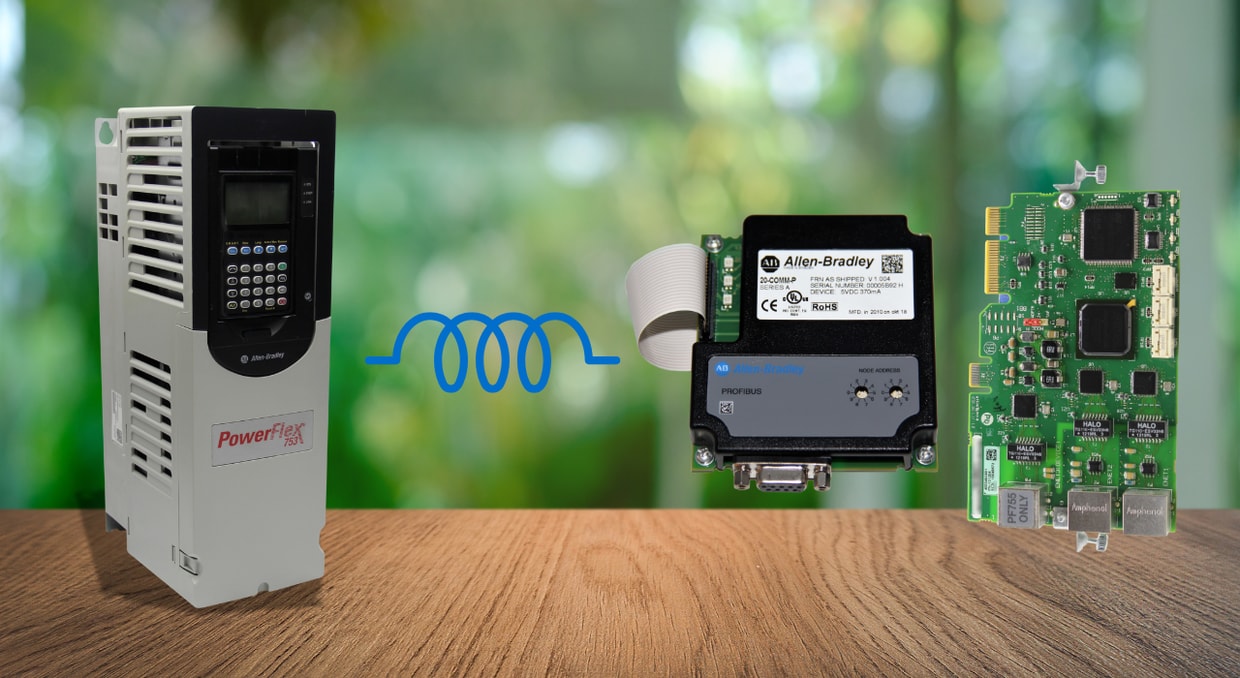
As a wise person once said, “Communication is key.” While you may have heard that this is the case for various reasons, it rings true when discussing automation equipment, specifically the fieldbus. Some plants speak EtherNet/IP while others may stick with Profibus. Some even still shout in DeviceNet, as if it were 2004. The PowerFlex 750, being the multilingual powerhouse that it is, will listen, translate, and keep everything running smoothly. With a lineup of swappable communication modules and native Ethernet/IP on board, it fits in whether your plant is state-of-the-art or still catching up. Let’s take a look at just what the 750 series can do.
EtherNet/IP
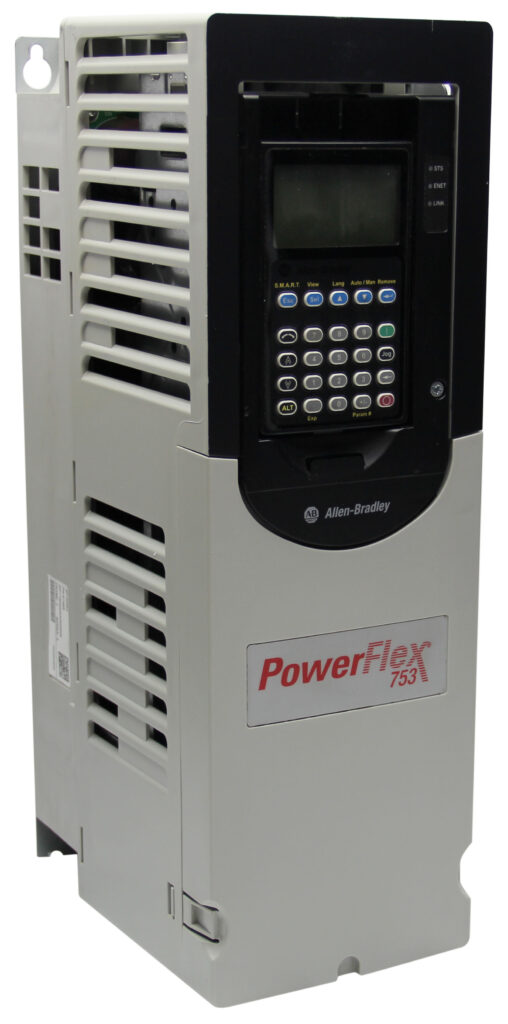
The 755 includes an Ethernet port out of the box, providing native support for topologies such as Device Level Ring (DLR) and CIP protocol. This makes Ethernet/IP the easiest way to get a 755 talking to a Logix controller. It handles everything from speed reference to status monitoring, fault codes, and even energy usage data. Since it’s Ethernet-based, you can even layer in other services, such as remote monitoring, diagnostics, and system-wide time synchronization. You can expect speeds of up to 10/100 Mbps. To add Ethernet to a 753, you would either need to use a 20-750-ENETR or 20-COMM-E optional card. The 20-COMM-E will need a communication carrier card, such as the 20-750-20COMM or 20-750-COMM-F1.
Unfortunately, Ethernet/IP does come with its drawbacks. In high-noise environments or long-distance runs, you will need to plan carefully with shielded cabling, managed switches, and proper grounding. However, this applies to any Ethernet setup.
Profibus
Ah, our favorite purple cable is used extensively with Siemens-centered factories. Profibus DP has been the backbone of many industrial networks for decades, and while it may not be the newest technology, the 750 series plays nicely with it, assuming you have the right adapter. Specifically, the 20-COMM-P or 20-750-PBUS communication modules let the 750 series interface directly with Profibus DP or DPV1 systems. Once installed, the drive can exchange cyclic I/O data with the PLC, respond to parameter read/write requests, and fit seamlessly into an existing Siemens or mixed-architecture setup.
Where Profibus still shines is in determinism and simplicity. Timing is rock solid, configuration is straightforward once you’re in that ecosystem, and it doesn’t rely on Ethernet infrastructure. That makes it attractive in applications where network behavior must be absolutely predictable, such as in synchronized lines or batch processing.
The downside is that the wiring is serial, speeds top out at 12 Mbps, and diagnostics are more limited than those of Ethernet/IP or ProfNet.
ProfNet
Ah, our favorite green cable! ProfNet is a newer, Ethernet-based version of the tried-and-true Profibus. It supports speeds of up to 100Mbps, and with a response time of < 1ms, it’s suitable for high-speed applications. Since they use the standard Ethernet connector, they can be connected to Ethernet switches as well.
With the 20-750-PNET or PNET2P module installed, the drive slots into ProfNet networks with Siemens PLCs and mixed automation environments that prefer green cables over purple ones. Like Ethernet/IP, it supports real-time cyclic I/O and acyclic parameter messaging. However, ProfNet also brings features like IRT (Isochronous Real-Time) to the table for applications that require precise timing. Think multi-axis coordination or synchronous motion control.
It’s a solid fit for process-heavy industries or any plant migrating away from Profibus but staying inside the Siemens ecosystem. And because it rides standard Ethernet wiring, you can take advantage of existing infrastructure without reinventing the whole topology.
That said, it’s not quite as plug-and-play in a Rockwell system. If you’re using Logix controllers, integration gets messy. You’ll likely need a gateway device or layered configuration to make the handoff work smoothly. While ProfNet is technically available on the 750 Series, it’s primarily for users already living in a ProfNet-native world.
If that’s you? Great. Drop in the module and keep the conversation going. If not, Ethernet/IP is still the path of least resistance.
DeviceNet
If you’ve been around older plants, especially those that have Rockwell in it through and through, then there’s a decent chance that DeviceNet is still running somewhere in the background. Sure, it’s not the flashiest protocol out there, but it’s hung around for good reasons: it’s simple, deterministic, and just works… most of the time.
The PowerFlex 750 line supports DeviceNet through either the 20-COMM-D module or the 20-750-DNET option card. Install one of these and your drive slots into an existing DeviceNet network. It’ll handle basic control, status, and diagnostics via cyclic I/O messaging, and with the right EDS file, most PLCs will recognize it without much hand-holding.
DeviceNet, however, is showing its age. Its based on CANbus, which means that speeds top out at 500Kbps and drops as cable length increases. Diagnostics are minimal, network scaling is limited, and troubleshooting can be a chore if you don’t have the right tools on hand. Compared to Ethernet, it’s like going back to dial-up from fiber optics.
Still, there’s value in keeping it around, especially in retrofit projects or facilities where tearing out existing infrastructure isn’t an option. The PowerFlex 750 gives you that option, and that’s what matters. You can modernize the drive without overhauling the whole network.
Other Protocols
While Ethernet/IP, Profibus, DeviceNet, and ProfNet cover the bulk of industrial networking needs, the PowerFlex 750 Series doesn’t stop there. It supports a handful of other protocols, some more common than others, giving you the flexibility to match nearly any setup.
Let’s start with Modbus TCP. It’s one of the most widely adopted open protocols in industrial automation, especially when you’re dealing with mixed-vendor environments. The 750 Series supports it through the 20-COMM-M module. It’s not as tightly integrated as Ethernet/IP, and you won’t get fancy diagnostics or tag-based naming, but it’s great for simple control and status reporting across Ethernet. If you’re trying to keep things straightforward or working with legacy Modbus gear, this is the module you’re looking for.
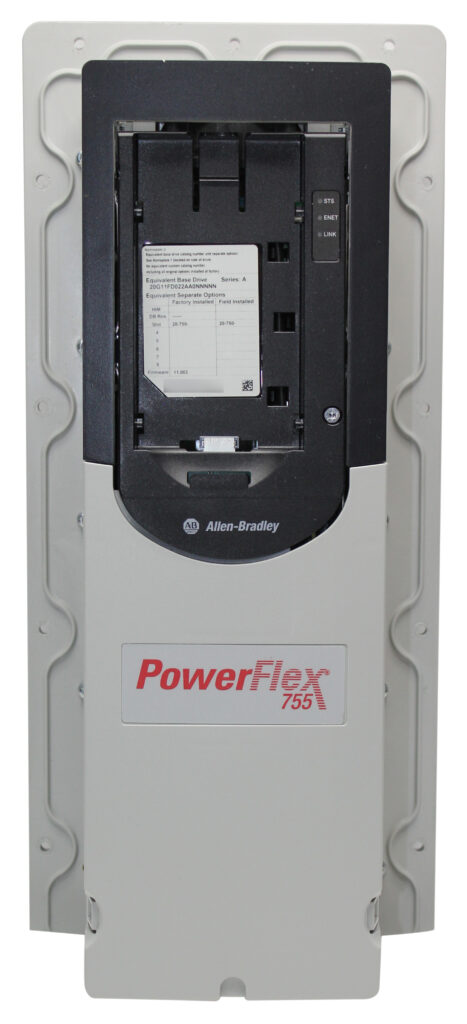
Then there’s ControlNet, which used to be the go-to for Rockwell systems needing deterministic control over coaxial or fiber media. The 750 Series still supports it through 20-COMM-C or 20-COMM-Q modules, but it’s largely being phased out in favor of Ethernet-based alternatives. If you’re in a plant that still runs on ControlNet, the 750 won’t force you to rewire.
You’ll also find support for BACnet/IP, LonWorks, and HVAC-focused Modbus RTU (via the 20-COMM-H). These show up more in building automation than on the factory floor, but it’s good to know they’re there, especially if your drives are managing HVAC, chillers, or rooftop units rather than conveyors and cranes.
And for the truly old-school setups, there’s RS-485 DF1 with the 20-COMM-S. It’s slow, simple, and serial, but it works in a pinch when you need basic command and feedback over long distances with minimal bandwidth.
So, regardless of the language your system uses, whether it’s modern Ethernet, legacy serial, or something in between, the PowerFlex 750 Series can likely accommodate it. All it takes is the right module.
Final Thoughts
Automation is never a one-size-fits-all solution, and the PowerFlex 750 series understands that. Although it does a good job of providing a bridge to different communication languages through its drop-in cards, allowing you to avoid being locked into a single architecture, vendor, or protocol. The drive works with the system you have now, and the one you’ll probably have five years from now.
Looking to upgrade your fieldbus setup or finally get that PowerFlex 755 talking to the rest of your line? We’ve got the drives, the modules, and the answers. Whether you’re replacing a failed DeviceNet adapter, retrofitting for Modbus TCP, or setting up a fresh EtherNet/IP install, DO Supply can help.
Give us a call or send us an email. Our team knows these systems inside and out, and we’ll ensure you have the right gear for the job. We also offer repair services and include a two-year warranty on many of our products, so you’re covered even if things go sideways.
DO Supply Inc. makes no representations as to the completeness, validity, correctness, suitability, or accuracy of any information on this website and will not be liable for any delays, omissions, or errors in this information or any losses, injuries, or damages arising from its display or use. All the information on this website is provided on an "as-is" basis. It is the reader's responsibility to verify their own facts.