Choosing Between PowerFlex, Kinetix, and Ultra Drives: A Practical Overview
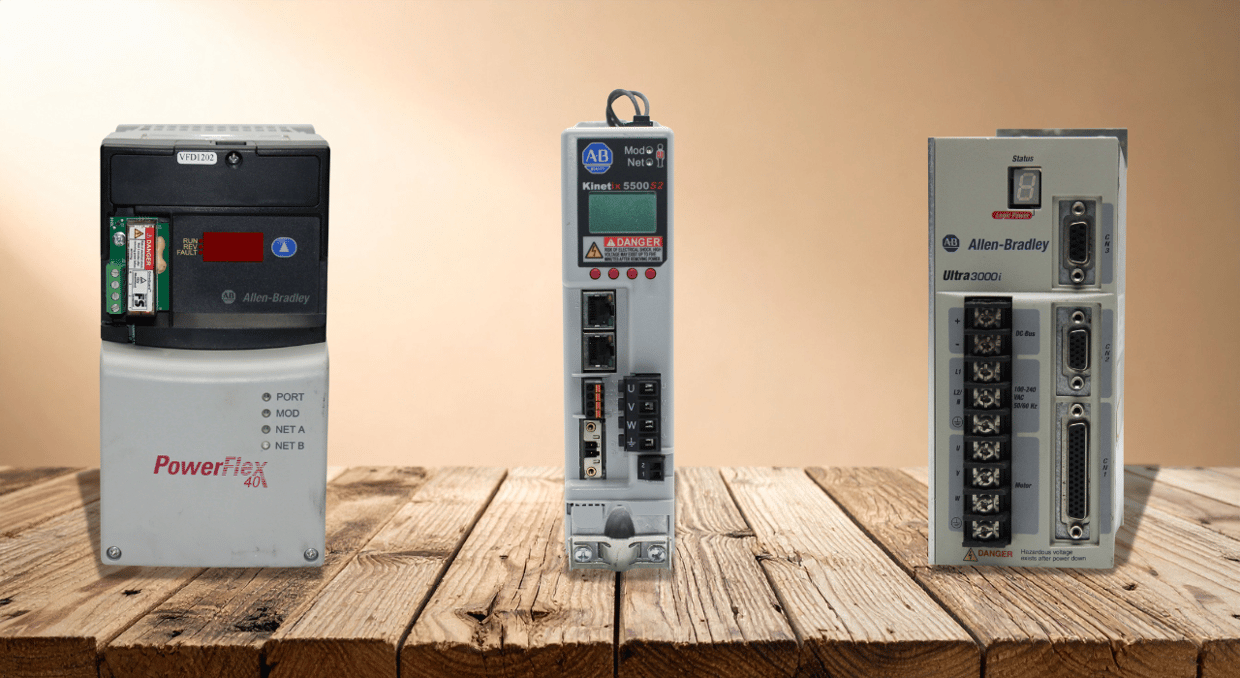
Selecting the optimal drive for your application is an all-important task that impacts your motion control system’s overall cost of ownership, performance, and efficiency. Allen-Bradley’s Kinetix, PowerFlex, and Ultra drives are cutting-edge motion control solutions designed for specific applications. Each drive series offers distinct levels of control, precision, and cost-effectiveness. As such, understanding the differences between the three Allen-Bradley drive families is critical when determining which drive series is the best match for your application needs.
- Kinetix Servo Drives: These drives provide precise position, torque, and speed control using closed-loop technology. They feature advanced features that offer complex motion control capabilities, high performance, rapid deceleration and acceleration, and high precision. Such features include adaptive auto-tuning, CIP Motion instructions for multi-axis cams and gearing, virtual torque sensing, and notch filtering (to reduce resonance).
The drives also require a feedback mechanism (e.g., an encoder) to continuously monitor and adjust the position of the connected motor(s). This is why they are often paired with permanent magnet synchronous motors equipped with high-resolution feedback devices (encoders/resolvers). Various Allen-Bradley Kinetix drives also support single-cable solutions for feedback, brake, and power functions, simplifying system installation and wiring.
A typical Kinetix servo drive system architecture includes:
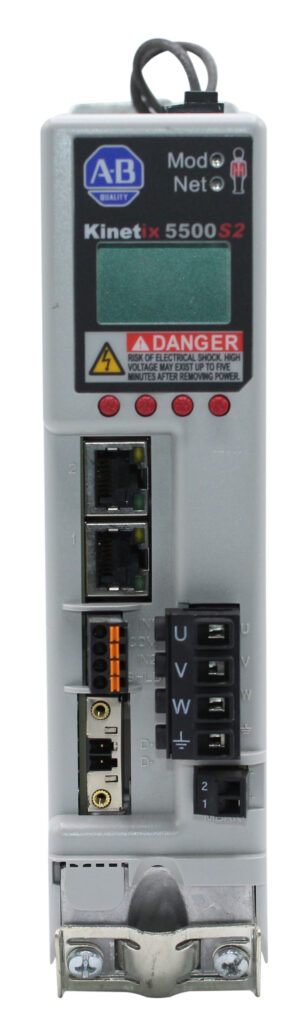
- Single-/multi-axis Servo drive(s): Provides precise current or torque control with bandwidths that exceed 1 kHz.
- Permanent Magnet Motors: Provide high torque density and low inertia for dynamic responsiveness.
- High Resolution Feedback: Absolute encoders (20-bit+) that provide accurate positioning and speed feedback.
- Integrated Motion Controllers: They carry out sophisticated motion profiles like electronic camming, position synchronization, and gearing.
The Kinetix drive series features a variety of drive models, including the Kinetix 5100/5300/5500 (single-axis EtherNet/IP drives with power ratings of 0.3 to 14.6 kW) and the high-power Kinetix 5700 multi-axis drives offering 1.6-112 kW power ratings. These drives are ideal for applications that require rapid acceleration, precise position control, and synchronization. Classic applications include CNC machining, robotics, printing presses, packaging machinery, multi-axis conveyors, and other motion control applications that demand intricate, repeatable, and synchronized movements.
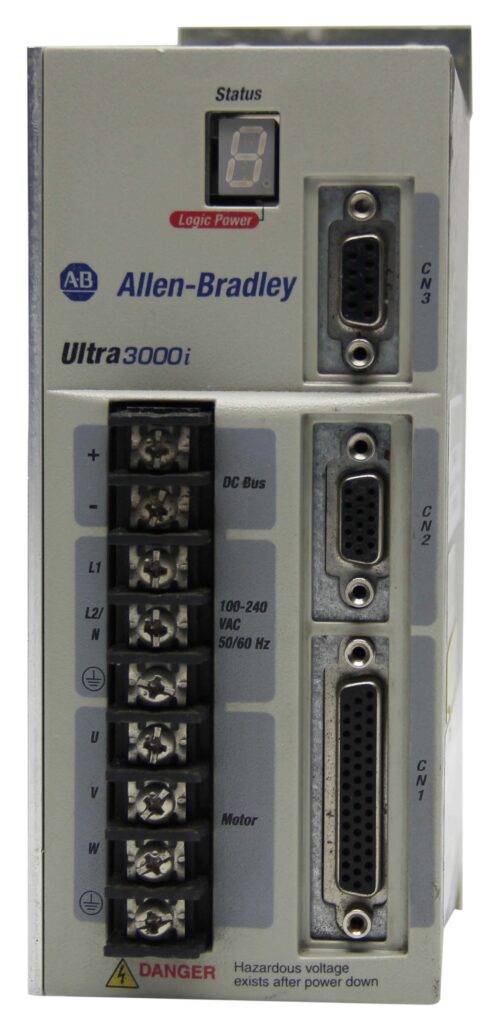
- Ultra Servo Drives: These drives are primarily optimized for high-performance motion control systems that require seamless integration with Allen-Bradley Logix controllers through SERCOS interface. They provide precise control, integrated motion control functionality, ease of use, and application versatility. They’re compatible with a wide selection of Kinetix servo motors, offering a broad range of connectivity options, functions, and power platforms. They are suitable for machine control architectures requiring either complex or simple motion profiles. Common applications include material handling, flying knife, indexing, and converting.
The Allen-Bradley Ultra servo drive series offers 0.5 to 15 kW power output options for 200V-class AC input and 3 to 22 kW for 400V-class input. The servo drives in this series also require separate power-supply modules (12 or 24V DC) to properly operate their digital I/O and an external +5V supply to maintain logic power. They are available with multiple interface types, including analog command, fiber-optic SERCOS, and DeviceNet encoders. However, even though Ultra servo drives are equipped with high-resolution encoders (both absolute and incremental) and can index or run fixed motion profiles, they lack the integrated networking capabilities provided by Kinetix servo drives.
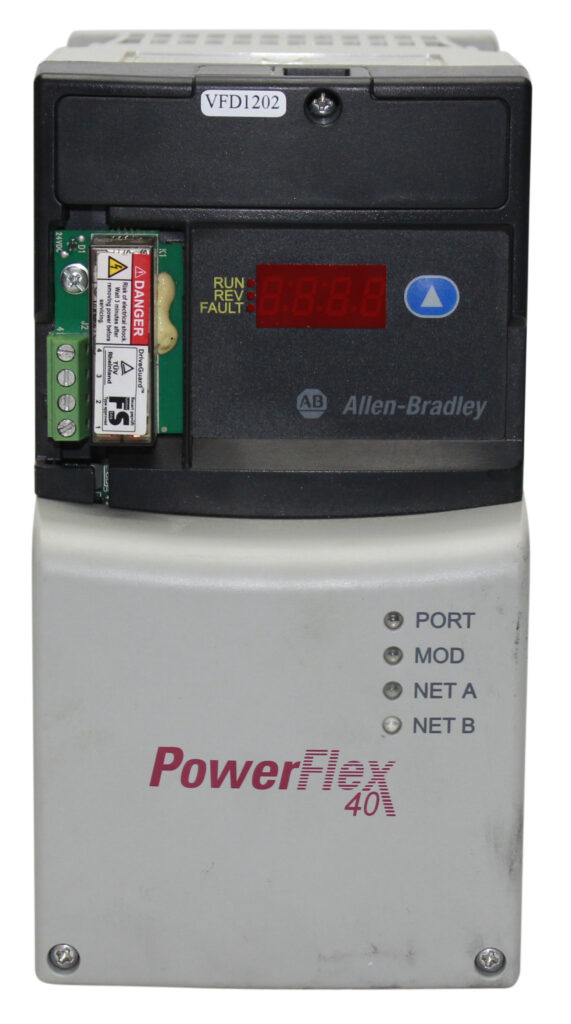
PowerFlex AC Drives: These drives are designed to control the torque and speed of AC induction motors using Sensorless Vector control or Volts per Hertz (V/Hz) technologies. They are widely used in a broad range of commercial and industrial applications. Typical applications include compressors, fans, conveyors, pumps, manufacturing/processing machinery, and other applications that require velocity control without high-precision positioning.
- PowerFlex AC drives generally offer more robust performance, lower costs, and higher energy savings compared to Kinetix and Ultra servo drives. They regulate motor speed and minimize energy consumption by varying the voltage and frequency of the AC power supplied to the connected motor(s). The key architectural components of a typical PowerFlex AC drive are:
- DC Bus: Converts AC input into variable DC, then generates variable AC output.
- IGBT-based Inverters that switch at high frequencies (2-16 kHz) to produce PWM (Pulse Width Modulation) waveforms.
- Control Algorithms: Open-loop Volts-per-Hertz, flux vector control, or closed-loop vector control with encoder feedback.
- Energy Optimization Circuits: Automatic voltage regulation and power factor correction
Technical Comparison
- Power Range: PowerFlex and Kinetix overlap in power: for small to medium kW (up to ~15 kW), either technology could be employed (though Kinetix would need a servo motor). Kinetix 5700 extends significantly higher (multi-tens of kW) with multi-axis modules. The Ultra 3000 had a maximum power output of 22 kW on 400 Volts. Kinetix or separate PowerFlex drives in parallel would be preferred for higher power requirements.
- Control and Feedback: PowerFlex AC drives are designed to operate in either open-loop (Sensorless) or closed-loop modes based on motor speed or current, making them suitable for controlling induction motors. They are not inherently aware of the absolute motor shaft position. In contrast, Kinetix and Ultra servo drives always depend on encoders or other feedback mechanisms for commutation and precise position control. In practice, PowerFlex drives can also work with encoders, but they are primarily intended for speed control.
- Precise Positioning: Kinetix and Ultra servo drives are paired with permanent-magnet servo motors with higher torque-to-inertia ratios and the ability to hold their position when stopped, whereas PowerFlex drives pair with induction motors, which have more inertia and lack self-holding torque. As a result, Kinetix and Ultra servos allow for quick acceleration and deceleration with precise positioning, while PowerFlex drive systems are more suitable for continuous, less-dynamic loads.
- Communication and Integration: Modern PowerFlex and Kinetix drives support EtherNet/IP and integrate with Allen-Bradley Logix controller platforms (ControlLogix/CompactLogix). Kinetix drives use CIP Motion and CIP Safety protocols to provide synchronized multi-axis control and integrated safety across a single network. PowerFlex drives connect via standard EtherNet/IP or DeviceNet ports, and some can execute multi-axis motion tasks when coordinated by a Logix controller. Ultra servo drives do not support EtherNet/IP; instead, they rely on DeviceNet or SERCOS interface, and they require separate tuning and diagnostic tools.
- Safety Options: Kinetix drives have built-in STO (Safe Torque Off) or Safe Stop via CIP Safety, and newer PowerFlex drives have STO supporting safety-related applications rated up to PLd (Category 3), whereas older drives (Ultra or earlier VFDs) did not have these functionalities.
- Performance and Features: Kinetix servo drives offer more bandwidth (current-loop ~1 kHz and velocity-loop ~300 Hz in many models), allowing for faster response to load changes compared to typical PowerFlex AC drives (which are generally limited to a few hundred Hz loops). For example, Kinetix 5700 models include multi-gigabit performance and advanced servo algorithms, whereas comparable PowerFlex VFD models depend on flux-vector loops.
Both Kinetix and PowerFlex drive families now provide regenerative alternatives, with Kinetix 5700 DC bus regeneration and PowerFlex755TR active front-end features that return regenerative energy from connected motor(s) back to the supply line. Kinetix servo drives inherently support advanced motion profiles (such as electronic camming, gearing, and multi-axis sync) and are available in compact form factors (single-module drives), unlike older multi-module Ultra servo drives.
Typical Applications
- High-Speed Robotics and CNC Machining: Choose Kinetix or Ultra servo drives for multi-axis robots, CNC spindles, and gantry systems. These applications require accurate, rapid, and well-coordinated movements. When paired with PowerFlex AC drives for spindle control, Kinetix servo drives enable advanced route navigation. An example of such an application is the robotic arms used in packaging applications.
- Pumps, Fans, Blowers: These machines operate continuously at varying speeds and benefit greatly from the energy savings provided by PowerFlex AC drives. They don’t require the precise control provided by Kinetix and Ultra servo drives.
- Packaging/Assembly Lines: Kinetix and Ultra servo are commonly used to control pick/place arms and indexing tables, whereas PowerFlex is used in conveyors and feeders. All three drive series can achieve coordinated motion (e.g., conveyor tracking), but the servo drives more precise control.
- Palletizers and Material Handling: Kinetix and Ultra servo drives are perfect for use with stacker cranes and multi-wheel shuttles that require precision positioning. Whereas PowerFlex VFDs are suitable for simple belt conveyors.
- Presses and Punches: Cutting or pressing machinery that requires controlled motion frequently uses servo-based force/position control. However, VFDs in vector mode or dedicated servo presses with hydraulic support may be used for extremely heavy inertia loads.
- Legacy Ultra Systems: Any machine using Ultra drives (earlier Rockwell/Allen-Bradley systems) that is still in service is effectively locked to servo-type operation. In such instances, engineers often replace Ultra drives with Kinetix series drives (after any necessary rewiring and programming updates).
- Hybrid Systems: Most modern-day motion control applications implement both servo and VFD drive technologies, where PowerFlex drives are used for speed control and Kinetix/Ultra servo drives for high-precision positioning. A variety of PowerFlex and Kinetix drives support EtherNet/IP and Logix controller connections, which simplifies integration of the two drive series.
Pros and Cons
PowerFlex AC Drives
- Pros: They are available in a wide range of power options and at a reasonable cost for conventional motor control. Advanced vector control, harmonic mitigation, and regeneration options are available with PowerFlex 755TL and 755TR drives, resulting in high energy efficiency for pumps and fans applications.
- Cons: They are less capable of precise position and velocity control. They provide low torque at high speeds in the absence of a feedback loop. Their slower torque response and higher inertia make them unsuitable for extremely dynamic or high-bandwidth motion control tasks. Not intrinsically multi-axis (each axis is independent unless controller-coordinated), and earlier models lack built-in safety or position feedback features without add-ons.
Ultra Servo Drives
- Pros: Ultra servo drives are very reliable and provide high-performance servo control. They are also available with a variety of interface options via SERCOS or DeviceNet protocols, which allow them to accommodate older control systems.
- Cons: Outdated technology, thus requiring costly repairs or migrations. Bulky installations with separate control power supplies. They have no built-in safety features, nor do they support modern communication protocols like EtherNet/IP and EtherCAT; instead, they use DeviceNet or the proprietary SERCOS interface. Limited availability of parts and technical support.
Kinetix Servo Drives
- Pros: High power density and precision. Faster control loops and encoder feedback provide excellent torque control at all speeds, allowing for precise synchronization across several drive axes. Built-in advanced motion features (cams and gears) and safety options (SS1 [Safe Stop 1] and STO [Safe Torque Off]), which can be accessed on a single EtherNet/IP network, facilitating simplified system design. Regenerative features that increase energy efficiency in dynamic cycles. Compact drive modules with single-cable (power-feedback-brake) motor connections that significantly reduce installation time.
- Cons: Higher overall cost of ownership and complexity. They require compatible servo motors and encoders, which increases overall system costs (unlike PowerFlex drive systems, which require less expensive AC induction motors). System configuration and tuning are more sophisticated (although newer Kinetix drives feature auto-tuning). Heat dissipation can be a concern under heavier loads, although this is often mitigated by regeneration. For low-cost or simple speed control requirements, the servo capabilities provided by Kinetix drives may be excessive.
In Summary
The choice between PowerFlex, Kinetix, and Ultra drives hinges on two fundamental application requirements — precision control versus operational efficiency. PowerFlex AC drives provide energy-efficient speed control for AC induction motors used in fans, pumps, or conveyors, while Kinetix and Ultra servo drives provide high-performance, single-axis/multi-axis motion control for more demanding applications like robotics, CNC machining, and precision positioning. Modern PowerFlex and Kinetix drives use similar networking and control platforms such as EtherNet/IP and Logix controllers, simplifying selection. Altogether, users ought to weigh many factors when selecting between the three drive families, including cost, energy efficiency, dynamic response, supported communication protocols, and required precision.
Here at DO Supply, we take pride in our vast selection of Kinetix, PowerFlex, and Ultra drives, all available to ship on the same day! Along with them, we have countless PLCs and motors from brands such as Allen-Bradley, Mitsubishi, Omron, Schneider Electric, and more. We also have a fantastic team of technicians available to fix broken hardware and keep your automation solution running smoothly. If this sounds like something you need, then give us a call or email us today!
DO Supply Inc. makes no representations as to the completeness, validity, correctness, suitability, or accuracy of any information on this website and will not be liable for any delays, omissions, or errors in this information or any losses, injuries, or damages arising from its display or use. All the information on this website is provided on an "as-is" basis. It is the reader's responsibility to verify their own facts.