Kinetix 3 vs. Kinetix 300: Choosing the Right Entry-Level Motion System
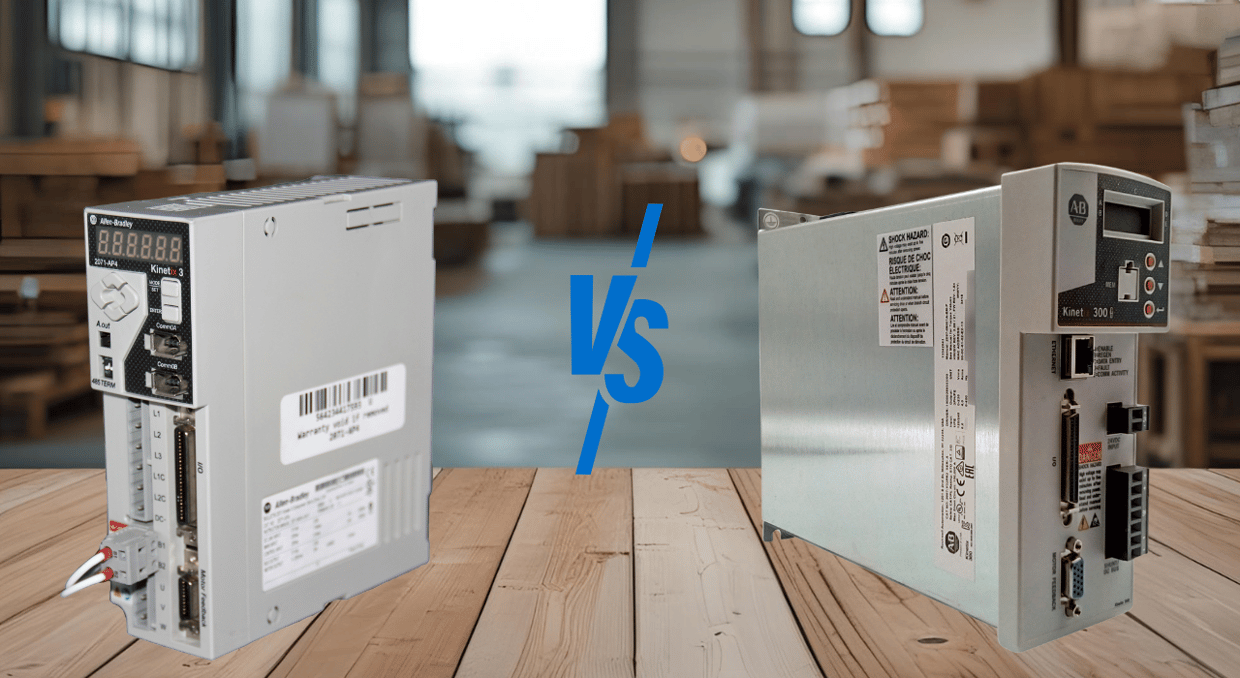
Let’s talk entry motion control, specifically the Kinetix 3 and 300. When designing a smaller automation task, it’s easy to assume that the Kinetix 3 and 300 are basically the same. After all, they’re both marketed as entry-level, low-axis drives to run small motors, but there’s more to it than that. One thrives as a standalone drive while the other belongs in coordinated motion with Logix integration and Ethernet/IP.
So, which one would best fit your machine or budget? That’s the question we’re looking to resolve today, so let’s break down the differences between these brother drives and help you answer that question.
The Kinetix 3
The Kinetix 3 is a lightweight drive designed for simpler automation tasks that require a single axis of motion. Its main selling points are that you don’t need a full PLC network to run it and that it is plug-and-play, with automatic motor recognition for L-Series rotary motors, TL-Series linear actuators, and LDL-Series and LDC-Series linear motors. This makes it very user-friendly for those who don’t know how to integrate full automation systems and want to add a bit more complexity to their smaller machines.
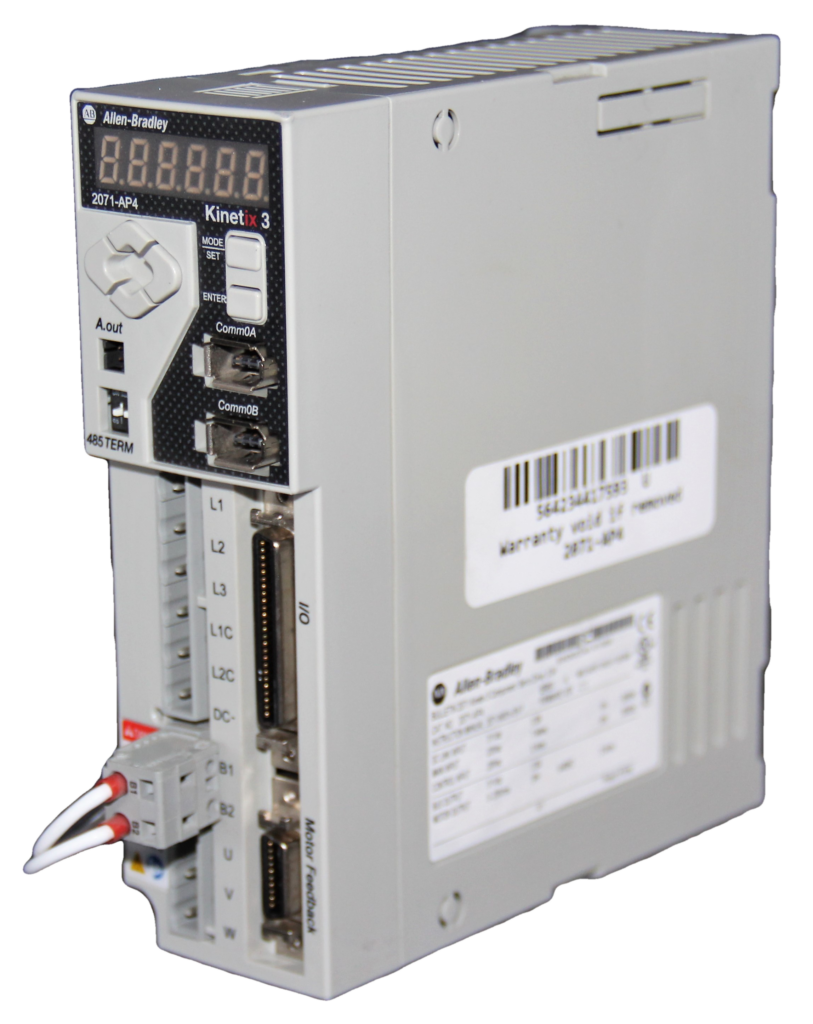
The various applications you will see with these drives range from indexing tables and laboratory automation equipment to solar panel tracking, electronics assembly, and other predetermined processes that rely on local signals, such as limit switches, sensors, or external pulses. Their compact size allows them to fit into smaller applications without worrying about running out of space. As for power specifications, these drives support motors ranging from 50 W to 1.5 kW, operating on 170V or 264V AC single- or three-phase input. We have a more in-depth guide to the various Kinetix 3 drives and their specifications here if you’d like to dig in a bit deeper.
These drives also feature digital and analog I/O, pulse train, and Modbus-RTU for enhanced flexibility when configuring. You can also expect indexing on up to 64 points through serial communication or through its digital I/O. This all adds up to a lightweight budget drive without unnecessary and costly bells and whistles.
The Kinetix 300
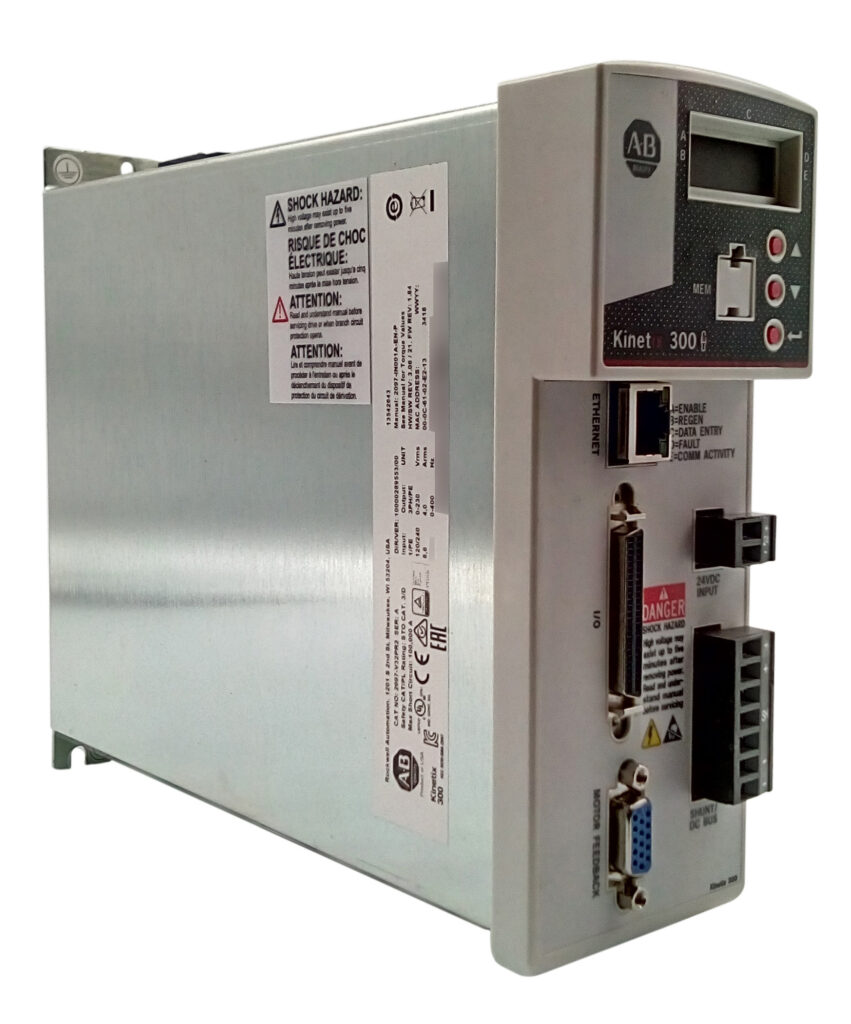
The Kinetix 300 takes a more integrated and digital step forward. These drives are designed to be run and configured over Ethernet/IP, a widely adopted industry standard that allows users to avoid relying on a dedicated motion network. This drive was designed to handle more advanced motion tasks, particularly when multiple axes need to work together. Whether it’s synchronized conveyors, robotic arms, or a carton erector with three different servos moving in rhythm, the Kinetix 300 is right at home.
The way it works is that each Kinetix 300 controls a single axis by using EtherNet/IP communication to share motion data in real time. This allows for coordinated motion tasks, such as electronic gearing, camming, or axis following. All things that the Kinetix 3 is unable to do. You can use up to four Kinetix 300s under a central controller, depending on the system design.
Indexing also plays a huge role in the Kinetix 300. It offers five different indexing types, including S-curve and trapezoidal moves, and a 32-index capability. Other features include velocity and current control, absolute and incremental position with or without registration, electronic gearing, analog input control, and step and direction control. These drives also have Safe Torque Off functionality.
Power-wise, the Kinetix 300 picks up where the Kinetix 3 leaves off, handling 4W to 3.0 kW, with support for both single-phase and three-phase 120 to 460V input, depending on the model. It also provides more flexibility in terms of motor compatibility, encoder feedback options, and I/O for system feedback and safety signals. For a deeper dive into the Kinetix 300, we have a comprehensive breakdown available here (https://www.dosupply.com/tech/2024/07/15/all-you-need-to-know-about-the-kinetix-300-series-drives/).
The Kinetix 3 and 300 Side by Side
Now that we have seen what each drive can do on its own, the real question is where they land when you’re making a decision. They may both live in the “entry-level” category, but they do solve different problems.
If your process leans more towards the simpler side, one that requires consistent, repeatable actions without syncing or network chatter, then the Kinetix 3 is your best option. It’s inexpensive, simple to wire, has motors and actuators that are plug and play, and does what it’s told. They’re smaller, dependable, and easy to work with. However, the moment you need more than one axis working together or want to hand control over to a central brain, then the Kinetix 300 is the stronger choice.
The biggest difference is coordination. The 300 passes motion data over Ethernet/IP, works seamlessly within a network architecture, and can manage multi-axis systems where timing is critical.
So, which one is “better”? That depends on what you’re building. If your goal is to move something simply and reliably, the Kinetix 3 handles it with minimal overhead. However, if you require timing, teamwork, and a bit more power, the Kinetix 300 is designed to deliver.
Final Thoughts
While each drive serves a different role, they are both highly competent pieces of industrial technology. The Kinetix 3 is all about getting motion done without the complexity of a more integrated setup, while the Kinetix 300 aims to take things a step further with its network support. However, if you’re still undecided about which one might be best for your machine or if you’re looking for a specific part number to repair or replace, please give our team at DO Supply a call. We stock both new, surplus, and refurbished drives, offer repairs, and back everything with our two-year warranty. So whether you’re looking to build new or keep the old running strong, we’ll help you find exactly what you’re looking for.
DO Supply Inc. makes no representations as to the completeness, validity, correctness, suitability, or accuracy of any information on this website and will not be liable for any delays, omissions, or errors in this information or any losses, injuries, or damages arising from its display or use. All the information on this website is provided on an "as-is" basis. It is the reader's responsibility to verify their own facts.