Allen-Bradley MicroLogix vs CompactLogix: Choosing the right PLC for Small Automation Projects
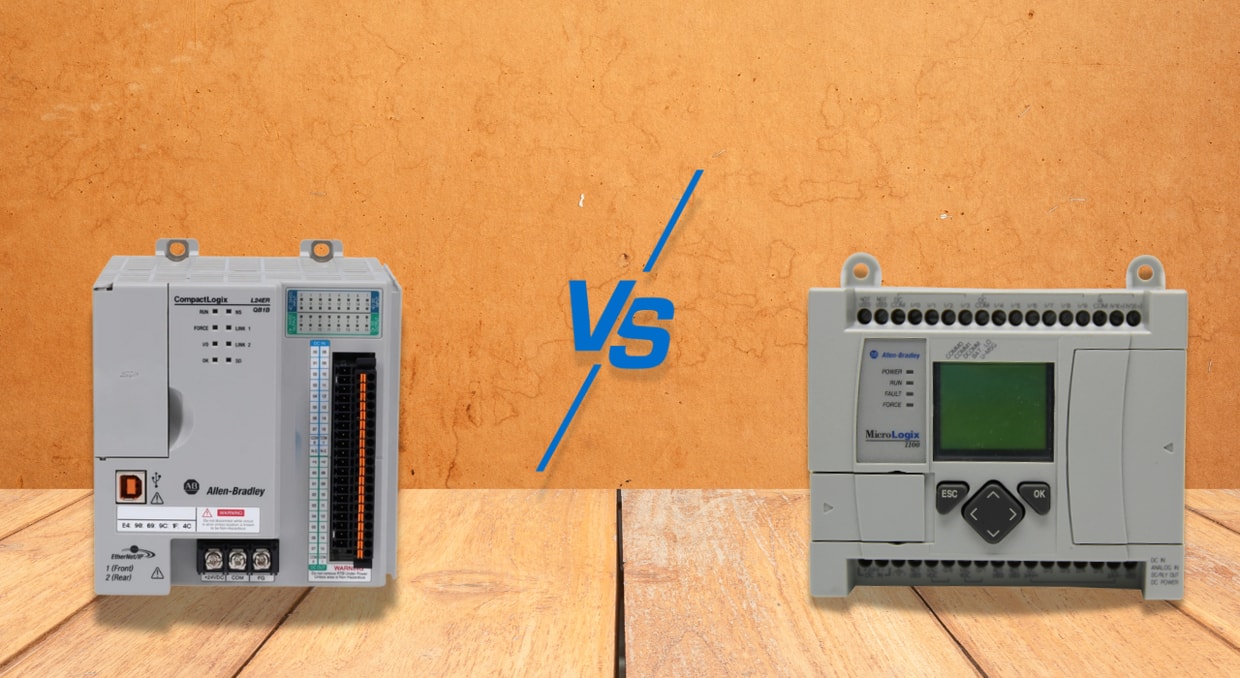
Programmable Logic Controllers are rugged, programmable industrial computers that are designed to control and monitor machinery in industrial settings. They are used for an extensive range of tasks, including material handling and quality control, as well as energy, manufacturing, and assembly line management. By executing user-programmed logic, PLCs are the essential building blocks of industrial automation, enabling greater precision, improved efficiency, and reduced system downtime across automation applications. Rockwell Automation, a global leader in industrial automation, offers two innovative Allen-Bradley PLC families ideal for small and mid-sized industrial automation applications: the CompactLogix and MicroLogix PLC series.
The MicroLogix PLC Family
The Allen-Bradley MicroLogix series provides five levels of control in an affordable, compact package. MicroLogix PLC controllers (Bulletin 1761-1766) are compact, self-contained PLCs that come with built-in I/O and basic networking capabilities. They are intended primarily for simple to moderate automation applications where physical space and budget are important considerations. Each MicroLogix controller variation includes a carefully balanced set of features and capabilities designed for basic control tasks.
All MicroLogix controller models provide:
- At least one integral enhanced RS-232C serial port, which supports DH-485, DF1 Half-Duplex, and DF1 Full-Duplex communication protocols
- Communication with operator interfaces, personal computers, and other PLCs and peripheral devices through Ethernet and DeviceNet, as well as through SCADA and open point-to-point protocols.
Available MicroLogix PLCs
The Allen-Bradley MicroLogix family offers five controller versions with increasing I/O points and memory. These include:
MicroLogix 1000
The MicroLogix 1000 controller series was the entry point into the MicroLogix family, offering basic control capabilities for particularly cost-sensitive applications with low I/O requirements. It can handle simple control tasks requiring 32 I/O points or lower, while utilizing only a fraction of the panel space of a full-sized PLC.
Key Features
- Extensive input and output specifications that provide a versatile control solution. Input options include DC, AC, and analog (voltage or current). Output options include MOSFET, relay, analog (voltage or current), and TRIAC.
- Both DC- and AC-powered MicroLogix 1000 controllers are available
- Fast processing, which allows a 1.5ms throughput time for a 500-instruction PLC program
- Pre-configured 1K data and programming memory (timers, integer, counters, bit, etc.) to ease controller configuration
- Supports advanced communications protocols, including EtherNet/IP and DeviceNet, through the 1761-NET-ENI and 1761-NET-DNI communication modules
- MicroLogix 1000 controllers with 24V DC inputs include an embedded high-speed (6.6 kHz) counter
- Modifiable DC input filters that allow users to customize the noise rejection capabilities and input response time of their MicroLogix 1000 controllers
MicroLogix 1100
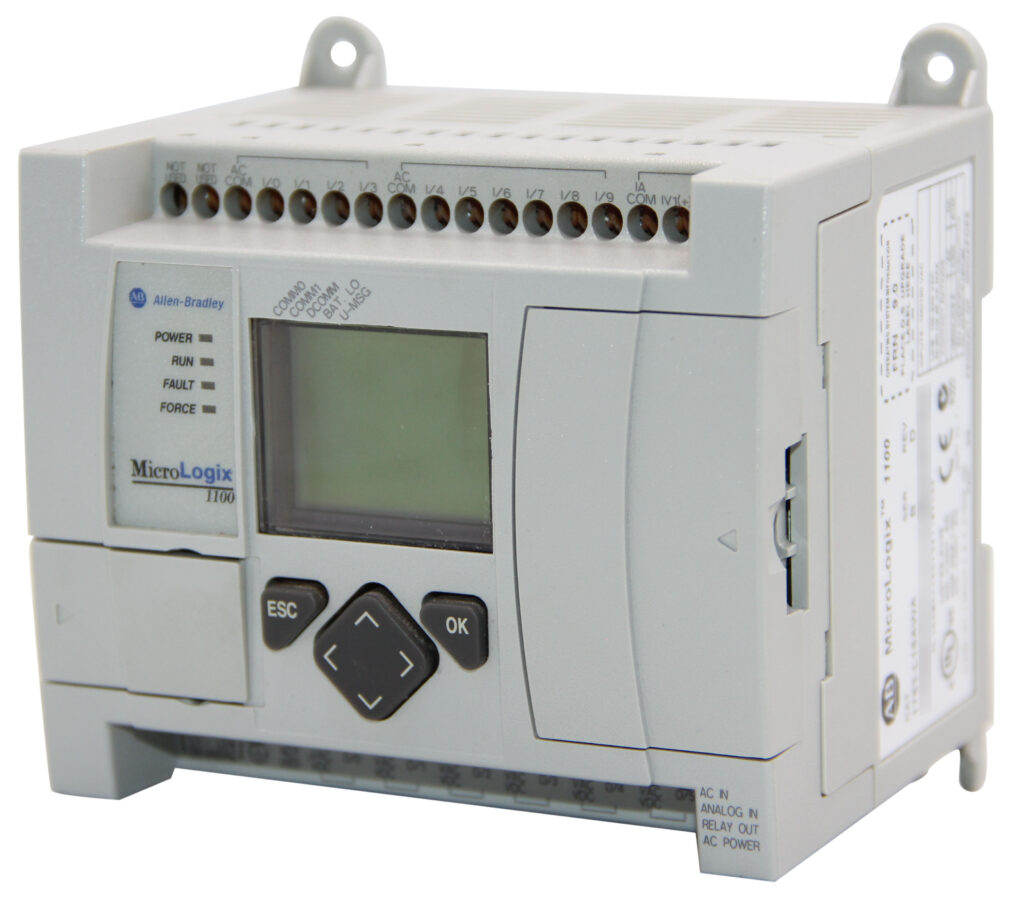
The MicroLogix 1100 (Bulletin 1763) controllers include embedded I/O points and an integrated Ethernet/IP port, providing greater connectivity and application flexibility. They are particularly suitable for SCADA RTU, material handling, and packaging applications. They are also an excellent choice for remote monitoring and memory-intensive applications that require limited I/O.
Key Features
- An integrated 100/10 Mbps Ethernet/IP port that supports high-speed peer-to-peer messaging
- Inbuilt LCD screens that display simple operator messages, I/O status, and controller status
- Online editing functionality that allows program modifications while the controller is still running, reducing development time and aiding in troubleshooting
- Fine-tuning capabilities for the operating control system and PID loops
- An embedded high-speed (40kHz) counter and two high-speed (40kHz) PWM/PTO outputs
- Up to 64K bytes recipe memory and 128K for data logging
- User program and user data memory, each 4K words
- Two inbuilt analog inputs (0 to 10V DC with 10-bit resolution)
MicroLogix 1200
As part of the Bulletin 1762 series, the MicroLogix 1200 controller provides modular expansion options via its built-in expansion port, allowing for customizable I/O configuration to meet application needs. The controller series is more appropriate for machines that require more I/O or analog control than the MicroLogix 1000/1100.
Key Features
- Built-in expansion ports for additional I/O
- 20KHz 32-bit integer counter for extended range, with eight modes of operation and direct control of outputs independent of program scan.
- Memory/RTC modules that allow for protected transportation of programs and data.
- Two trim potentiometers with a range of 0-250 for easy adjustments to counters, setpoints, timers, and more.
- Support for floating point data files containing up to 256 IEEE-754 values.
- Four interrupt inputs that allow for specified subroutines to run when specified conditions are detected from a sensor or field device.
MicroLogix 1400
The MicroLogix 1400 (Bulletin 1766) controller is one of the most capable offerings in the MicroLogix product line, with more I/O ports, a quicker high-speed counter, pulse train output, and improved network capabilities as compared to previous MicroLogix models. This makes it ideal for more demanding small to mid-size control applications. All MicroLogix 1400 models feature three embedded communication ports, offering robust communication options.
Key Features
- An embedded Ethernet port that opens up a wide range of capabilities, including email, messaging, and web servers
- Support for Ethernet/IP, DNP3, and Modbus protocols. By enabling Ethernet/IP connectivity, the MicroLogix 1400 bridges the gap between basic compact controllers and more advanced communication capabilities
- An RJ-45 interface that supports 10 to100 Mbps Ethernet/IP peer-to-peer messaging, DNP3 over IP, and the Modbus TCP/IP protocol
- Two serial ports (RS-232C/RS-485 combination port and an RS-232C port)
- Backlit LCD for I/O status, bit/integer monitoring or manipulation, and messages
- Online Editing functionality allows users to make edits to programming without any downtime
- Supports up to 7 expansion (1762 I/O) modules and 256 discrete I/O
MicroLogix 1500
The MicroLogix 1500 controller series features more I/O counts and more complex instructions than previous MicroLogix versions, as well as advanced capabilities such as removable memory modules and integrated specialty I/O modules. It has a larger battery-backed RAM (up to 14 KB of user memory), two serial ports (a combined RS-232/RS-485 port and an RS-232 port), but no Ethernet port. It utilizes RSLogix 500 and replaceable memory modules. The MicroLogix 1500 demonstrates scalability within the MicroLogix series, serving as an intermediate step between simple MicroLogix controllers and the more powerful CompactLogix platform.
Key Features
- Field-upgradable flash operating system
- Support from up to 512 points of IO with expansions
- 14K of non-volatile user memory
- Ability to scan up to 1K of user programs in under 1 millisecond
- Features two 20KHz counters, with eight modes of operation, and support for either PTO or PWM output
The CompactLogix PLC Family
The Allen-Bradley CompactLogix PLC series is a more advanced, scalable controller platform, specially designed for medium-complexity automation applications that demand higher performance, greater connectivity, and more sophisticated control capabilities. CompactLogix PLC controllers, as part of Rockwell Automation’s Integrated Architecture system, provide multi-discipline control by managing discrete, drive, motion, process, and safety applications on a single Logix platform. This unified approach to automation offers substantial benefits for industrial applications that need coordinated control across multiple technologies. It employs the Allen-Bradley Logix 5000 architecture in a smaller form factor.
The CompactLogix family features multiple controller models that provide a wide range of performance and control capabilities. They include:
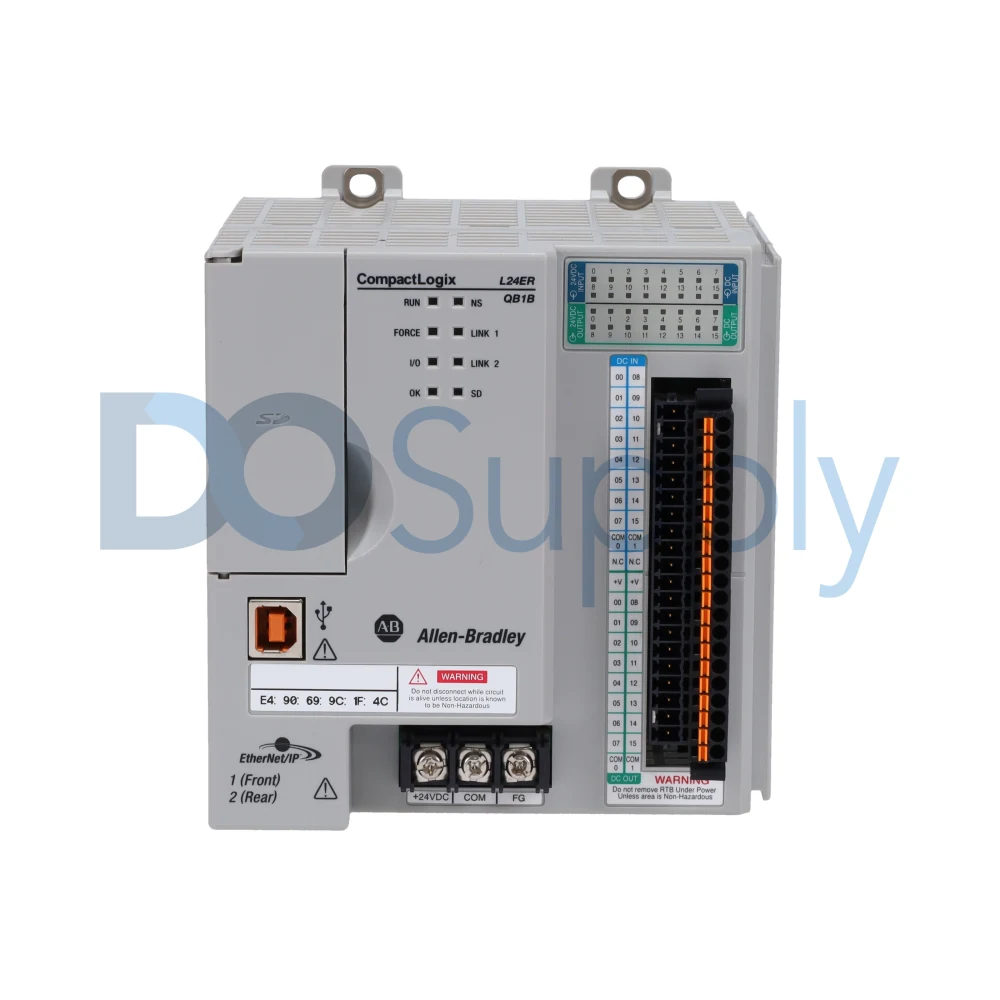
- CompactLogix 5480: This is a line of Allen-Bradley real-time Logix controllers that run Windows 10 IoT Enterprise. They support integrated Windows applications, such as data gathering, predictive analytics, and computations. They also support high-speed I/O, linear/Device Level Ring (DLR) network topologies, and motion control. They are suitable for large and mid-size applications requiring faster data throughput and high-performance control.
- CompactLogix 5380: This controller series outperforms previous CompactLogix generations in terms of performance, capacity, productivity, and security features. It provides faster processing speeds, higher performance, and larger memory capacity for sophisticated applications. It is a great choice for smarter machines that require advanced motion control and integrated safety.
- CompactLogix 5370: CompactLogix 5370 controllers incorporate integrated safety, built-in energy storage, and an SD card with up to 2GB memory for faster program save and restore. They provide Integrated Motion on EtherNet/IP, allowing maximum scalability. They are ideal for mid-size and small applications that require few I/O points and low axis motion counts.
- CompactLogix 1769: These controllers provide state-of-the-art Logix control, communications, and I/O functions in a modular, compact form factor. They provide a cost-effective control system with built-in Ethernet/IP and ControlNet communication ports, compact I/O modules, an integral serial port, and a 1769-SDN interface module.
- CompactLogix 1768: This series pioneers the concept of scalable, performance-oriented Logix control in a small footprint, supporting a wide range of applications from simple discrete control to more complicated motion control. It is perfect for machine-level control applications that require advanced I/O, network, and motion control capabilities.
Technical Comparison: MicroLogix vs. CompactLogix
It’s essential to understand the technical differences between the MicroLogix and CompactLogix controller series to ensure that you select the best match for your automation needs.
| MicroLogix Controllers | CompactLogix Controllers | |
| Typical Applications | Simple control tasks, standalone machines, basic automation | Complex control systems, smart machines, integrated automation |
| Control Capabilities | Basic discrete, analog, and simple motion control | Advanced discrete, process, analog, motion, and safety control |
| Communication Protocols | Ethernet/IP (select models), RS-485, RS-232 serial communication | Primarily Ethernet/IP for high-speed communications |
| System Scalability | Limited to controller-specific I/O capacity | Highly scalable with modular I/O expansion options |
| Hardware Architecture | Fixed or limited modular I/O | Fully modular with specialized I/O modules |
Key Selection Considerations
Here are some key considerations to keep in mind when selecting between a MicroLogix and CompactLogix controller platform:
- Complexity of Application: Determine the control requirements of your automation project beyond basic logic functions. While MicroLogix controllers can perform basic discrete and analog control, CompactLogix controllers are better suited for applications involving motion control, process control, data handling, and safety integration.
- System Expansion Requirements: Consider both current and anticipated future I/O needs. The fixed configuration of MicroLogix controller platforms may limit I/O expansion options, whereas the modular architecture of CompactLogix systems readily accommodates additional I/O, communication modules, and specialty modules.
- Networking and Data Integration: Determine the requirements for data sharing with other systems. MicroLogix controllers with Ethernet/IP connectivity can seamlessly interface with other devices, while CompactLogix controllers provide more reliable networking, higher data throughput, and better support for distributed systems.
Final Thoughts
While we wish we could give you a concrete answer now, deciding what PLC family is fit for you is highly dependent on your use case. Though if you still remain unsure as to which might be better, we always encourage readers to give us a call and we can help find equipment that would be suited for your particular use case. We also have an article here that goes over use cases for the MicroLogix PLC line here that may help! We DO Supply also carry PLCs from major brands, such as these Allen-Bradley offerings you’ve just read about. So come by and check out our offerings today!
DO Supply Inc. makes no representations as to the completeness, validity, correctness, suitability, or accuracy of any information on this website and will not be liable for any delays, omissions, or errors in this information or any losses, injuries, or damages arising from its display or use. All the information on this website is provided on an "as-is" basis. It is the reader's responsibility to verify their own facts.