Sensor Selection Guide: How to Choose Between Inductive, Capacitive, and Photoelectric Designs
In the modern world, sensors are quite literally everywhere you see. Whether it’s the gyroscope in your phone detecting when you’ve lifted it so it can turn the screen on, or the TPMS in your car’s tires alerting you to low air pressure, sensors constantly translate the physical world into something machines can understand.
A sensor, in the broadest term, is a device that connects the physical world to its digital counterpart. It responds to a specific measurand, such as distance, pressure, light, or temperature, to give a usable output. Otherwise, how else would a machine know the temperature of ambient air, or the weight of a package sitting on a scale without elaborate mechanical linkages?
While thousands of sensors are used in everyday life, in automation the scope of sensors narrows considerably. On the factory floor, most sensing tasks boil down to one core question: Is something there, and if so, where?
In this guide, we focus on the most common and widely used sensor types: inductive, capacitive, and photoelectric. Each fundamentally detects objects, but does so in different ways. Where one shines, others may fall short, and today we will help you understand how they work and which might be best for your situation.
Inductive Sensors
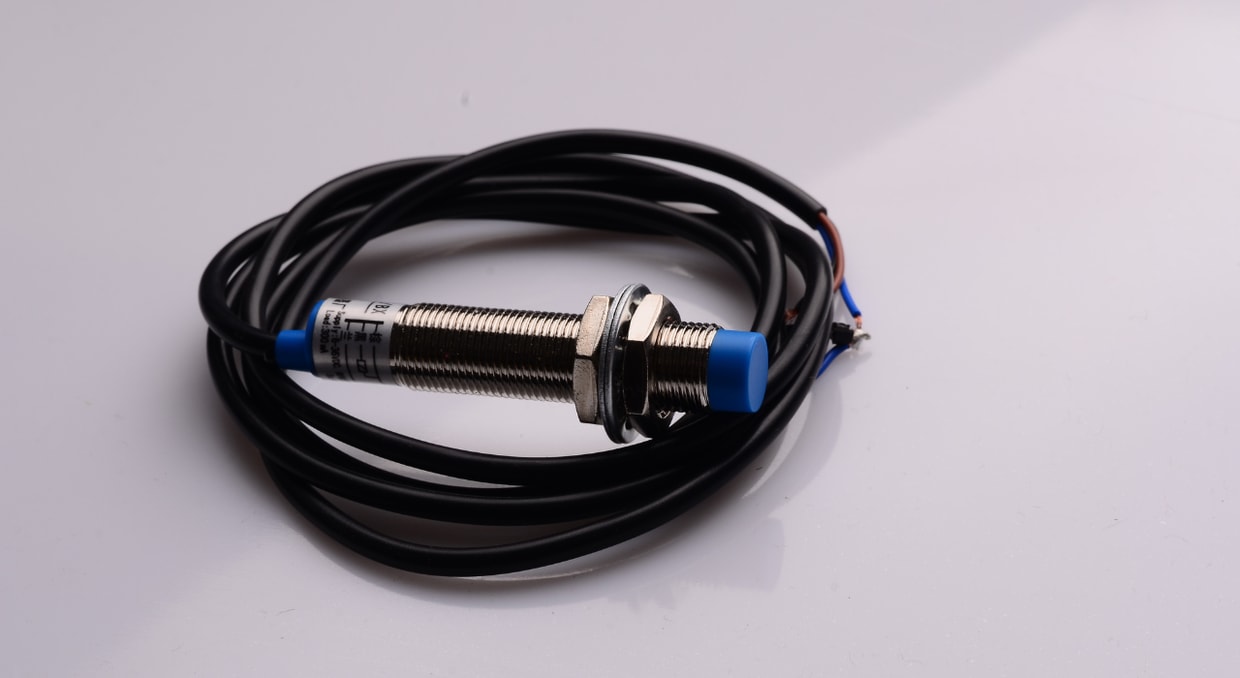
An inductive sensor, as the name implies, is a device that uses the principle of electromagnetic induction to sense whether a metallic object is close. Inside these sensors is an internal oscillator that drives alternating current through a coil, generating an oscillating magnetic field around the sensor’s sensing face.
When a conductive metallic object enters that magnetic field, eddy currents are induced within the metal, creating a secondary magnetic field that interacts with the sensor’s primary field. The sensor will continue to monitor the oscillator’s amplitude. When the metal object gets close enough, the oscillation amplitude decreases due to energy being dissipated by the eddy currents. This change in energy is recorded by the sensor’s internal circuitry and converted into an electrical output signal.
What They’re Made Out Of
A typical inductive sensor isn’t a complicated piece of tech and will include:
- Copper coil: A tightly wound copper inductor that’s usually wrapped around a ferrite core.
- Ferrite Core: Shapes and concentrates the magnetic field so that it is projected forward from the sensing face.
- Oscillator Circuit: Usually built from transistors, this drives the coil at tens to hundreds of kHz.
- Amplitude Detection Circuitry: Monitors how much energy the oscillator is losing as eddy currents form in nearby metal.
- Comparator: Decides when the signal drop is large enough to switch the output.
- Sensing Face: Non-magnetic, allows the magnetic field to pass through unrestricted.
Where Inductive Sensors Fit Best
You will often find inductive sensors fitted in applications that favor reliability over flexibility. If the target is metal and the environment is harsh, inductive sensing is often the simplest and most dependable solution.
One of the biggest strengths of inductive sensors is their environmental immunity. Since inductive sensors don’t rely on light or physical contact, they are largely unaffected by dust, oil, grease, vibration, or changing ambient lighting.
This pairs them nicely with:
- Machinery
- Conveyors
- Manufacturing
- Elevators
- Robotics
- Safety Systems
Capacitive Sensors
Capacitive sensors are similar to inductive sensors, but instead of relying on magnetism to detect metallic objects, they use electric fields to detect non-metallic objects. It checks if the electrical environment in front of it has changed.
Inside the sensor, an oscillator energizes a sensing electrode, creating an electric field that extends outward from the sensing face. This electrode behaves similarly to one plate of a capacitor. The surrounding air and everything else entering the sensing zone form the dielectric and the opposite plate.
As a result, when an object approaches the sensing face, it alters the system’s capacitance. Materials with a dielectric constant higher than that of air, such as plastics and liquids, increase the effective capacitance. The sensor’s internal circuitry monitors this change; once it exceeds its defined threshold, the sensor transitions to its output state.
What’s Inside a Capacitive Sensor
Internally, capacitive sensors share some similarities with inductive sensors, but the key components reflect their sensitivity to electric fields:
- Sensing Electrode: Typically, a copper pad or ring on the PCB that generates the electric field.
- Shield Electrode: Used to control the shape of the field and reduce interference from surrounding objects.
- Capacitance-sensitive oscillator: Changes frequency or amplitude as capacitance at the sensing face increases.
- Demodulation: Converts extremely small capacitance changes into a stable signal.
- Comparator: Determines when the detected change is large enough to trigger the output.
- Sensing face: Usually plastic or epoxy, allowing the electric field to project outward.
Because capacitive sensors measure changes on the order of picofarads, their internal electronics are designed to be highly sensitive.
Where Capacitive Sensors Take the Crown
As we explained earlier, capacitive sensors are well-suited for detecting non-metallic objects or for applications that require detecting multiple material types.
They are commonly used to detect:
- Plastic or glass containers
- Liquids through non-metallic walls
- Granules, powders, and bulk materials
- Paper, cardboard, or wood products
- Fill levels in bins, hoppers, or tanks
Going back to the distinct ability to sense liquids through non-metallic walls, this is where capacitive sensors really shine. For example, a capacitive sensor can detect the presence of liquid inside a plastic bottle without touching the product.
You can find these sensors in:
- Packaging
- Food and beverage
- Material handling
- Environmental sensing
- Process industry
Photoelectric Sensors
Photoelectric sensors are commonly referred to as photo eyes in the industrial automation sector. They are devices that determine an object’s distance, presence, or absence using a light transmitter and a photoelectric receiver. Photoelectric sensors come in different types, such as through-beam, retro-reflective, and proximity-sensing.
Through-Beam Photoelectric Sensor
If you have seen any heist-type movies, you may recall a classic scene where the protagonist must avoid touching red lasers to keep the alarm from sounding while they try to steal the treasure. This concept is how through-beam photoelectric sensors work. It uses an emitter to send an infrared signal to a receiver, which monitors the beam to confirm its presence. The beam is modulated at a specific frequency to enable the receiver to distinguish it from ambient light. When an object breaks the beam, the receiver switches its output state to indicate that an object has passed through.
Retro-Reflective Photoelectric Sensor
This type of photoelectric sensor integrates the emitter and receiver in a single unit. It will emit its light, and with the use of a reflector, will have that light reflected into its receiver. When an object passes in front of it, the light the receiver sees will be diffused. When this happens, the sensor detects the change and adjusts its output accordingly.
Due to this design, the retro-reflective sensor cannot detect shiny objects, as a smooth surface is too reflective and provides false information to the transmitter. Though using polarized retro-reflectors can help with this.
Where These Photo Eyes Rule
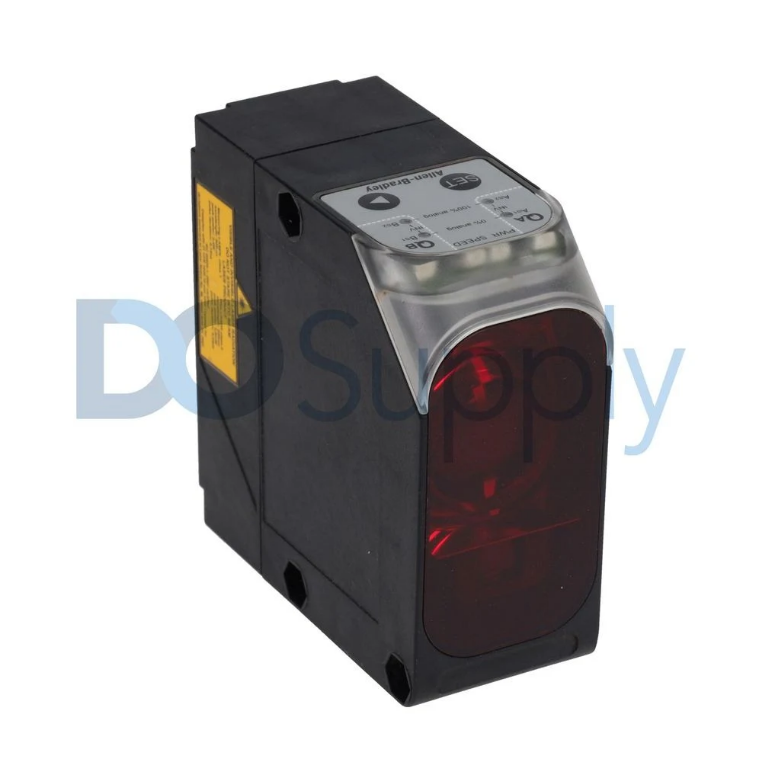
Photoelectric sensors are useful for detecting objects at distances beyond what capacitive and inductive sensors can achieve. Even compact photoeyes can reliably detect objects several feet away, and through-beam designs can reach distances that inductive or capacitive sensors simply cannot.
Because of this, photoelectric sensors are well-suited for:
- Conveyor systems
- Pallet detection
- Entry and exit detection
- High-speed motion
- Sensing objects with irregular shapes
When Might You Use These Sensors
The differences between these sensors are less about which one is “better” than which one fits the job at hand. Each sensing method has its strengths, weaknesses, and ideal operating environments.
Inductive Sensors
Inductive sensors are the best fit for harsh environments for sensing metallic objects.
These sensors rely on electromagnetic fields rather than optics or physical contacts to detect the presence of a metallic object. As a result, they can thrive and perform consistently in dirty, oily, or high-vibration environments.
Why it might fit:
- Extremely reliable and repeatable
- Immune to dust, oil, grease, and ambient light
- No moving parts or optics to wear out
- Excellent for high-cycle applications
Things to consider:
- Only detect metal targets
- Short sensing distances compared to photoelectric sensors
- Detection range varies by metal type
Capacitive Sensors
These sensors are best for non-metallic materials and level detection.
Capacitive sensors expand detection beyond metal by responding to changes in the electric field. This makes them useful when detecting plastics, liquids, powders, or mixed materials that inductive sensors cannot detect.
Why would you choose one:
- Can detect both metallic and non-metallic objects
- Effective for liquid and bulk material level sensing
- Can detect targets through non-metallic walls
- Flexible across many material types
What to keep in mind:
- Sensitive to moisture, dust buildup, and residue
- Requires careful adjustment for each application
- Nearby objects can influence sensing performance
- Less forgiving in unstable environments
Photoelectric Sensors
Photoeyes are best for long-distance, high-speed, or material-agnostic detection.
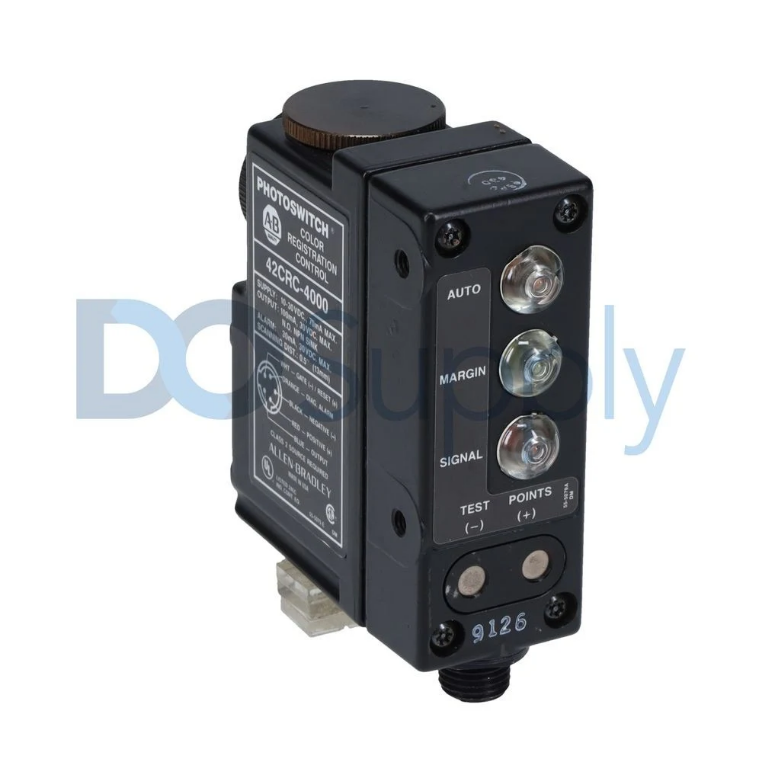
Photoelectric sensors are the go-to solution when distance or speed makes field-based sensing impractical. By using light instead of electromagnetic or electric fields, photoeyes can monitor large areas and detect small or fast-moving objects.
Reasons to implement:
- Longest sensing distances of the three
- Works with almost any target material
- Ideal for conveyors and product flow monitoring
- Capable of detecting small or irregular objects
Potential deal breakers:
- Performance depends on optical alignment
- Lenses and reflectors must be kept clean
- Shiny or transparent objects may require special configurations
- More susceptible to environmental contamination than inductive sensors
Bringing it All Together
Understanding how each sensor works will make the trade-offs for each sensor very clear and help avoid overengineering or misapplying sensors where they don’t belong. Each sensor also has its own subcategories, further optimising the options for your situation.
We also carry sensors like these in our store at DO Supply, including Allen-Bradley Photoswitch, laser, and proximity sensors, among others. We also offer supporting equipment, such as PLCs, motors, and drives, from trusted manufacturers. A 2-year warranty backs all our products, and we ship them the same or next day as a bonus! As always, thank you for reading.
DO Supply Inc. makes no representations as to the completeness, validity, correctness, suitability, or accuracy of any information on this website and will not be liable for any delays, omissions, or errors in this information or any losses, injuries, or damages arising from its display or use. All the information on this website is provided on an "as-is" basis. It is the reader's responsibility to verify their own facts.