How MicroLogix Simplifies OEM Designs and Small Machine Automation
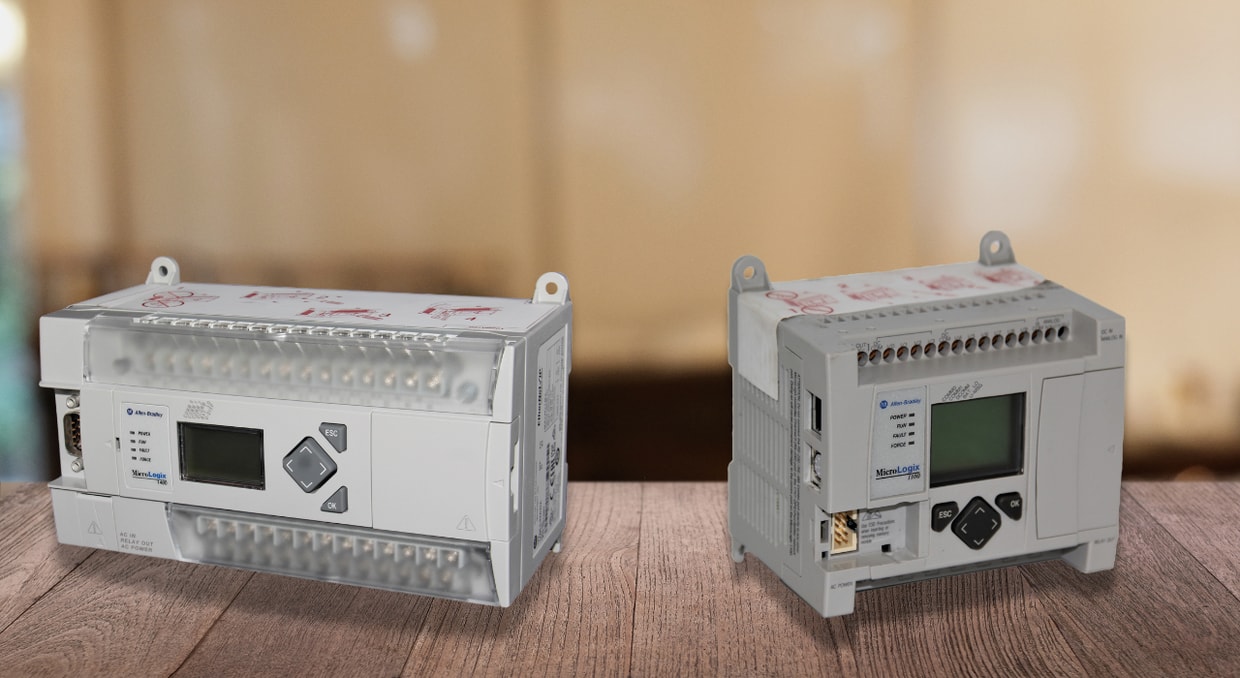
Designing an OEM system can be quite an ambitious endeavor. Every wire, sensor, and relay has to serve a purpose. For smaller systems, an additional challenge comes into play. Not only does the machine have to work, obviously, but it must do it without inflating the cost, complexity, or footprint of the control hardware. This is where Allen-Bradley’s MicroLogix PLC family steps in.
These controllers are built with the realities of small machine automation in mind: limited space, tight budgets, and the constant demand for reliability. Whether it’s a packaging line tucked in a corner of a factory floor or a self-contained water treatment skid running in a remote facility, MicroLogix controllers simplify control design by combining power, communication, and flexibility in a single, easy-to-integrate package.
Let’s get into how the MicroLogix fits the demands of compact OEM designs and tight spaces within machine automation.
First and Foremost, Size
We can’t start an article about small automation and MicroLogix PLCs without opening up about the size of these controllers. The MicroLogix varies in size depending on the model and configuration. The dimensions below are length, depth, and height with units of mm (in):
MicroLogix 1000: The smallest model in this line is 120 (4.72) x 40 (1.57) x 80 (3.15) while the largest is 200 (7.87) x 73 (2.87) x 80 (3.15). The minimum spacing for the controllers is greater than or equal to 50.8 (2) on both sides, as well as the top and bottom.
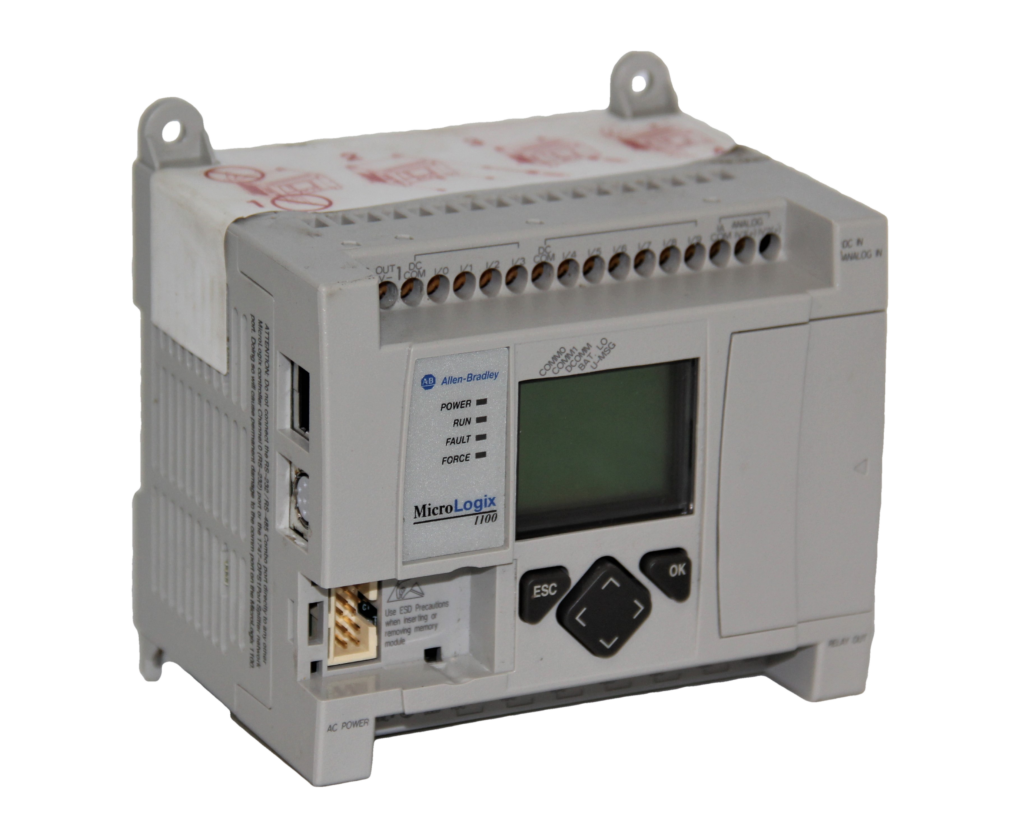
MicroLogix 1100: These controllers come in one set size: 110 (4.33) x 87 (3.43) x 90 (3.5), but they can expand further by attaching four 1762 I/O expansion modules on the side of them, each with an average depth of 87 (3.43). Allen-Bradley recommends 2 inches of ventilation clearance along the controller’s sides, top, and bottom.
MicroLogix 1200: This line measures 110 (4.33) x 87 ( 3.42) x 90 (3.54) to 160 (6.30) x 87 ( 3.42) x 90 (3.54) but will increase in size with up to six 1762 I/O add-on modules shared across the 1100 and 1400 MicroLogix controllers.
MicroLogix 1400: The 1400 comes in at 180 (7.08) x 87 (3.43) x 90 (3.5) and can expand with seven 1762 I/O modules.
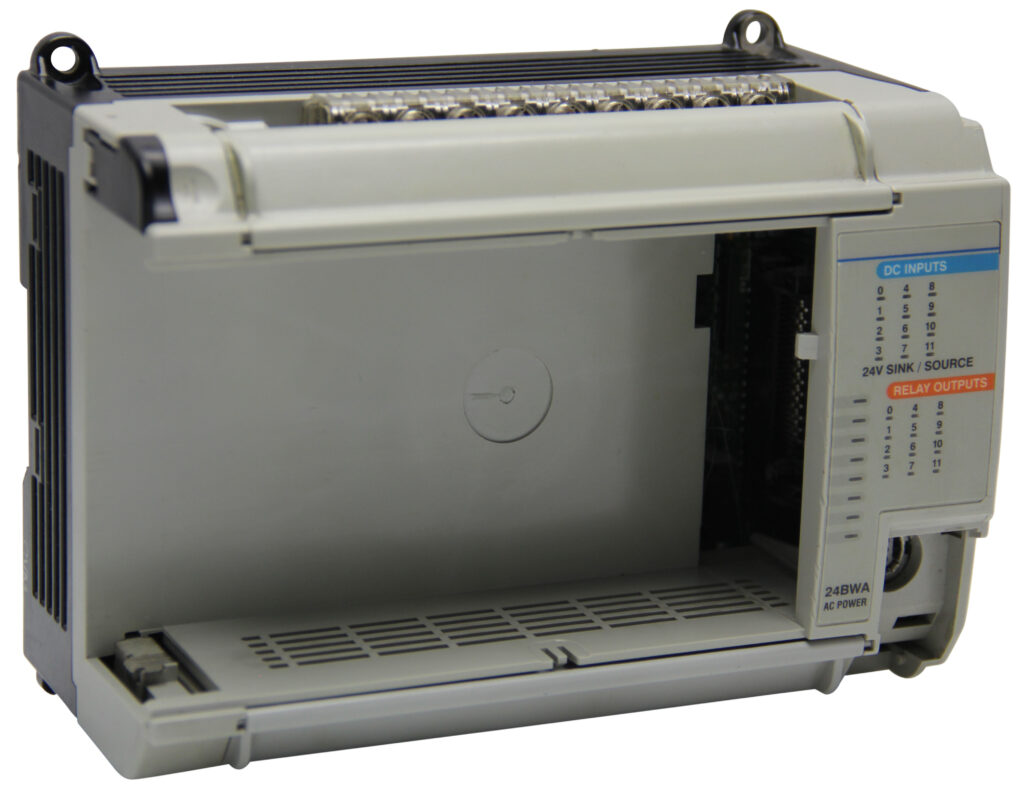
MicroLogix 1500: The 1764-24AWA, -24BWA, -28BXB models come in a length of 168 (6.62) and height of 138 (5.43). The depth will vary for which processor is chosen. Its final length will also be determined by the power supply and expansion modules that you configure it with.
Power Without Compromise
When controlling a machine with automated equipment, you want your controller to be responsive and reliable when the system demands it. This is where the MicroLogix family earns its place in OEM panels. As you just read, the controllers are very compact but can also pack a punch for smaller systems.
Let’s take a simple packaging line with photoeyes and stepper motors requiring millisecond-level coordination. A MicroLogix 1000 handles that effortlessly, with scan times around 1.5 ms and a 6.6 kHz high-speed counter. Move to a MicroLogix 1200, and you can drive indexing tables or small pick-and-place stations using 20 kHz pulse-train outputs and built-in PID loops, all from a controller small enough to mount next to a power supply. For remote sites, such as water or wastewater skids, the MicroLogix 1100 and 1400 introduce built-in EtherNet/IP and Modbus RTU, plus data logging up to 128 KB, letting operators trend flow or pump performance without external hardware.
When a design grows, let’s say from a single-machine packaging cell to a multi-axis material handling system, the MicroLogix 1500’s modular base and 14KB of memory scale right up without changing the programming style or network strategy. Across the entire lineup, OEMs get responsive control, proven reliability, and the flexibility to match the controller to the job rather than redesign the job for the controller.
Designed for the OEM Mindset
For most OEMs, the challenge is not getting a machine to run but running efficiently across dozens of builds, revisions, and configurations without reinventing the control system each time. The engineers at Allen-Bradley understood this and built the MicroLogix line to share the same architecture, instruction set, and development environment. That way, when one technician or engineer learns one, they’ve essentially learned them all.
On the hardware side, MicroLogix has the same philosophy of compact I/O footprints, shared 1762 expansion modules for the 1100, 1200, and 1400, and standardized communication ports to keep the layout simple. That flexibility is what makes the MicroLogix line a favorite for OEMs who produce variants of a base design. Say, a small filler one week and a twin-head labeler the next, all without needing to requalify an entirely new controller each time.
These microcontrollers are made for scalability in mind, so when an application runs smoothly on one model, expanding to a more capable controller is simplified due to the shared 1762 modules and logic platform.
Matching the Controller to the Machine
Naturally, every OEM has its preferred machine to use. It’s what defines its product line, after all. It might be a compact filler, a conveyor cell, or a small batching station that needs to perform flawlessly and predictably. The MicroLogix family makes matching the controller’s horsepower to the job easy, with performance and communication options that scale naturally as the design grows more complex.
For entry-level machines, such as compact packaging units or feeders, the MicroLogix 1000 offers the essentials without the overhead. Its 1.5 ms program throughput and up to 32 I/O points are more than enough to handle start-stop logic, sensor feedback, and basic interlocks.
Stepping up to the MicroLogix 1100 will have you enter the networked automation world. Its EtherNet/IP port allows peer-to-peer messaging and remote monitoring, making it a natural fit for remote water systems, conveyors, or small process skids that need both local control and data visibility. The built-in LCD and analog inputs give operators direct insight into system status without requiring an HMI, which helps keep costs down in compact panels.
Now, when the OEM design starts involving motion, timed batching, or multi-sensor coordination, the MicroLogix 1200 becomes the better choice. With 20 kHz high-speed inputs and a PTO/PWM output on DC models, it drives indexing tables, material feeders, or light assembly systems at home. Its ability to expand to six I/O modules (shared with the 1100 and 1400) means it can grow as machines add axes or functions over time.
Putting the connectivity of the MicroLogix 1100 and the strength of the 1200, the MicroLogix 1400 stands tall. With EtherNet/IP, Modbus RTU, and DNP3 support, plus 100 kHz counters and data logging up to 128 KB, it’s often used in HVAC, energy, and industrial monitoring systems. The built-in LCD can display floating-point process data or an OEM’s logo, which is a small but appreciated touch when showcasing a finished machine.
Finally, for OEMs pushing their small designs into large-system territory, the MicroLogix 1500 provides that extra headroom. With up to 512 local I/O, 14 KB of memory, and modular Compact I/O compatibility, it easily handles coordinated material handling or multi-axis motion control.
Final Thoughts
For some OEMs, it’s not all about the features but the one that quietly does the job, scales when needed, and doesn’t complicate things that should be simple. The MicroLogix family, like all of Allen-Bradley’s line-up, has become a trusted line-up across decades of automation. Whether it’s speed, communication, or I/O capacity, MicroLogix has you covered.
That’s why we at DO Supply are proud to offer exceptional service and a commitment to satisfaction when it comes to helping you order your own MicroLogix PLCs or anything else automation-related. If you have a broken drive or PLC that needs to be fixed, send it in! We have expert technicians on standby to get your automation equipment back on its feet and better than ever, all backed by our two-year warranty. So give us a call today!
DO Supply Inc. makes no representations as to the completeness, validity, correctness, suitability, or accuracy of any information on this website and will not be liable for any delays, omissions, or errors in this information or any losses, injuries, or damages arising from its display or use. All the information on this website is provided on an "as-is" basis. It is the reader's responsibility to verify their own facts.